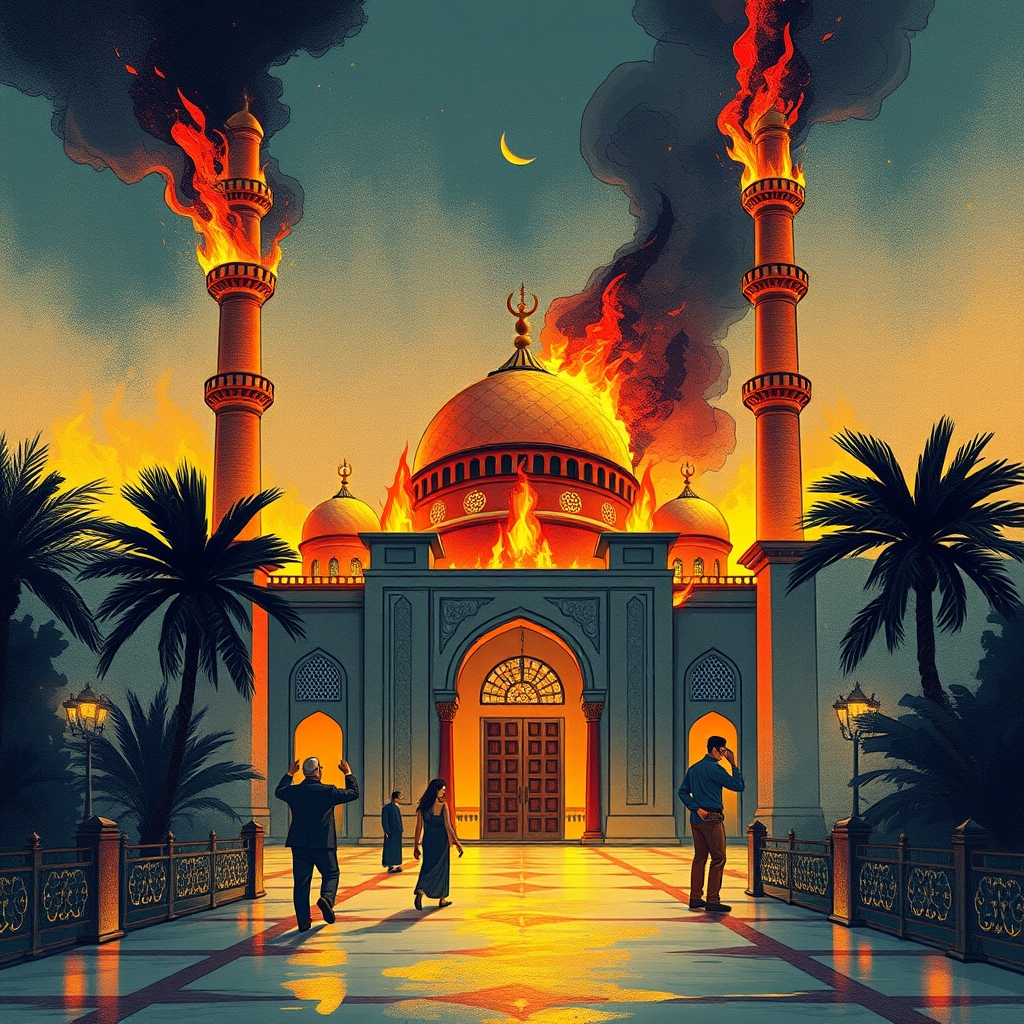
The arson and its symbolism
The Qusra mosque was nearly finished, fully furnished and slated to open within weeks. Abdel Azim Wadi, head of the village council, said the blaze erupted in the early hours and the attackers scrawled two bold Hebrew slogans. “Revenge Benayahu” references an Israeli settler killed in recent clashes in nearby Tell, while the second phrase frames the conflict as a blood-soaked redemption of the land.
In Kour, a similar fire turned a small community mosque to ash. Although the draft omits graffiti there, the coordinated attacks point to a shared motive: intimidate Palestinians and signal that settler grievances will be met with violence against religious symbols.
Netanyahu’s response and the security crackdown
The twin arsons sparked a wider surge of unrest that has already claimed four Palestinian lives and two Israeli soldiers. Netanyahu acted quickly: he ordered more troops across the West Bank, cancelled leave for soldiers stationed there, and authorized the arrest of roughly 70 Palestinians to contain the flare-up.
The Israel Defence Forces (IDF) announced an investigation into the mosque attacks and publicly condemned damage to holy sites.
Political backlash inside Israel
The incidents ignited a sharp debate in Israel’s political arena. Opposition figures and several Palestinian leaders accuse the prime minister of turning a blind eye to settler violence, saying the government’s heavy-handed focus on Palestinian militants ignores the threat from extremist settlers.
Hard-line cabinet members, especially Finance Minister Bezalel Smotrich, used the unrest to push for annexation of the West Bank—a move that would cement Israeli control over the territory captured in 1967. Smotrich’s advocacy highlights a growing rift: some argue a tougher line on Palestinians is needed for security, while others warn that rewarding settler aggression will only fuel more violence.
The cycle of escalation
The latest mosque arsons fit a pattern of retaliatory attacks that has broadened into a wider security clampdown. Israeli forces have closed major roads and launched operations in cities such as Nablus, restricting access to hospitals and other essential services. Framed as attempts to prevent “terror attacks,” these measures often worsen civilian hardship, stoking resentment and sparking further protests.
With national elections slated for October, Netanyahu faces mounting pressure to adopt a hardline stance against Palestinian militants. At the same time, settler-led provocations like the mosque burnings are on the rise. A government that tightens control over Palestinians while appearing to tolerate—or at least not swiftly punish—settler aggression creates a volatile mix that could spill beyond the West Bank.
Counter-argument from the establishment
The IDF’s condemnation of the mosque attacks and its promise of an investigation serve as the official counter-argument: the state does not condone attacks on religious sites, regardless of who commits them. Security officials say arresting Palestinians is necessary to prevent a spiral of attacks that could endanger Israeli civilians.
What to watch next
- Investigations: The IDF’s probe into the mosque attacks.
- Political rhetoric: Statements from cabinet members on annexation and settlement expansion.
- Security measures: Ongoing road closures and operations in Palestinian towns.
- Election dynamics: Developments as the October vote approaches.
Takeaway
The arson of mosques in Qusra and Kour shows how settler violence can spark broader conflict, testing the Israeli government’s ability to enforce the rule of law uniformly.