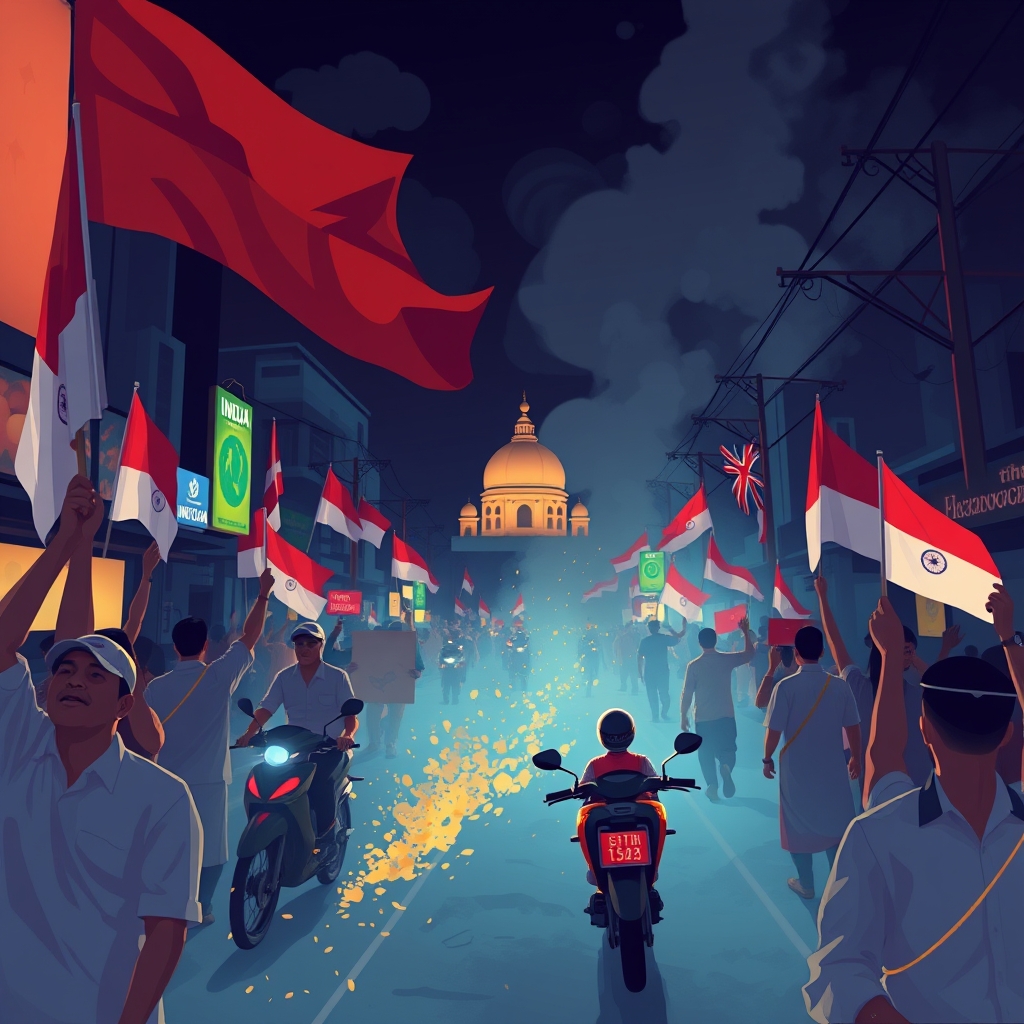
Civil Unrest in Indonesia: Protests Target Prabowo’s Economic Policies
Mass protests have erupted across Indonesia as citizens take to the streets to challenge the administration of President Prabowo Subianto. From fuel price hikes to controversial social welfare schemes, the growing domestic instability in Southeast Asia's largest economy presents a complex picture for regional geopolitics.
Economic Pressures and the Fuel Price Surge
The recent unrest, notably in Surabaya and Jakarta, stems from a direct hit to the pockets of the Indonesian populace. To manage budgetary pressures exacerbated by the ongoing conflict in West Asia—which has tightened global oil supplies—the Prabowo administration has raised the prices of non-subsidized gasoline by approximately 30%.
In Surabaya, on June 26, 2026, demonstrators gathered near the Grahadi State building, leading to clashes with law enforcement. Reports from the rights group KontraS Surabaya indicate that at least 24 protesters were detained following incidents where rocks were hurled at police and rubbish fires were lit in the streets. The economic strain of rising energy costs is acting as a catalyst for wider discontent against the central government's fiscal management.
Controversy Surrounding the Free Meals Programme
Beyond energy costs, President Prabowo’s flagship "free meals scheme" has become a significant lightning rod for criticism. While intended as a cornerstone of his political agenda to address food security, the multi-billion-dollar initiative has faced intense scrutiny for being fiscally wasteful.
Adding to the political volatility, the programme has been plagued by reports of mass food poisonings, leading to its partial suspension. Students in Jakarta have joined the fray, demanding an immediate halt to the spending on this scheme, arguing that the massive budgetary allocation is unsustainable given the current economic climate.
A Pattern of Growing Domestic Instability
The current wave of protests follows a pattern of increasing friction between the Indonesian state and its citizens. Following Prabowo's ascension to power in 2024, the country saw significant nationwide unrest in August and September. Those protests, which initially targeted lawmaker perks, escalated into violent confrontations with security forces following the death of a delivery driver.
The recent involvement of security forces in "firm actions" to disperse protesters in Surabaya highlights a recurring tension. With rights groups reporting previous fatalities and thousands of arrests, the administration faces the difficult task of balancing fiscal discipline with the maintenance of social order and public trust.
What It Means for India
Indonesia is a vital partner for India in the Indo-Pacific, and domestic instability there carries strategic implications for New Delhi:
- Maritime Security and ASEAN Stability: As a key pillar of ASEAN, a politically unstable Indonesia could impact regional cohesion and the collective ability of Southeast Asian nations to manage maritime security concerns in the South China Sea.
- Energy Market Volatility: Indonesia is a significant player in global commodity markets. Domestic unrest driven by oil price sensitivities may influence regional energy flows and price stability, indirectly affecting India's own energy security calculations.
- Strategic Partnership Continuity: India seeks deeper cooperation with Indonesia in defense and trade. Prolonged internal volatility under the Prabowo administration may divert the government's focus from outward-looking foreign policy and bilateral strategic initiatives with India.