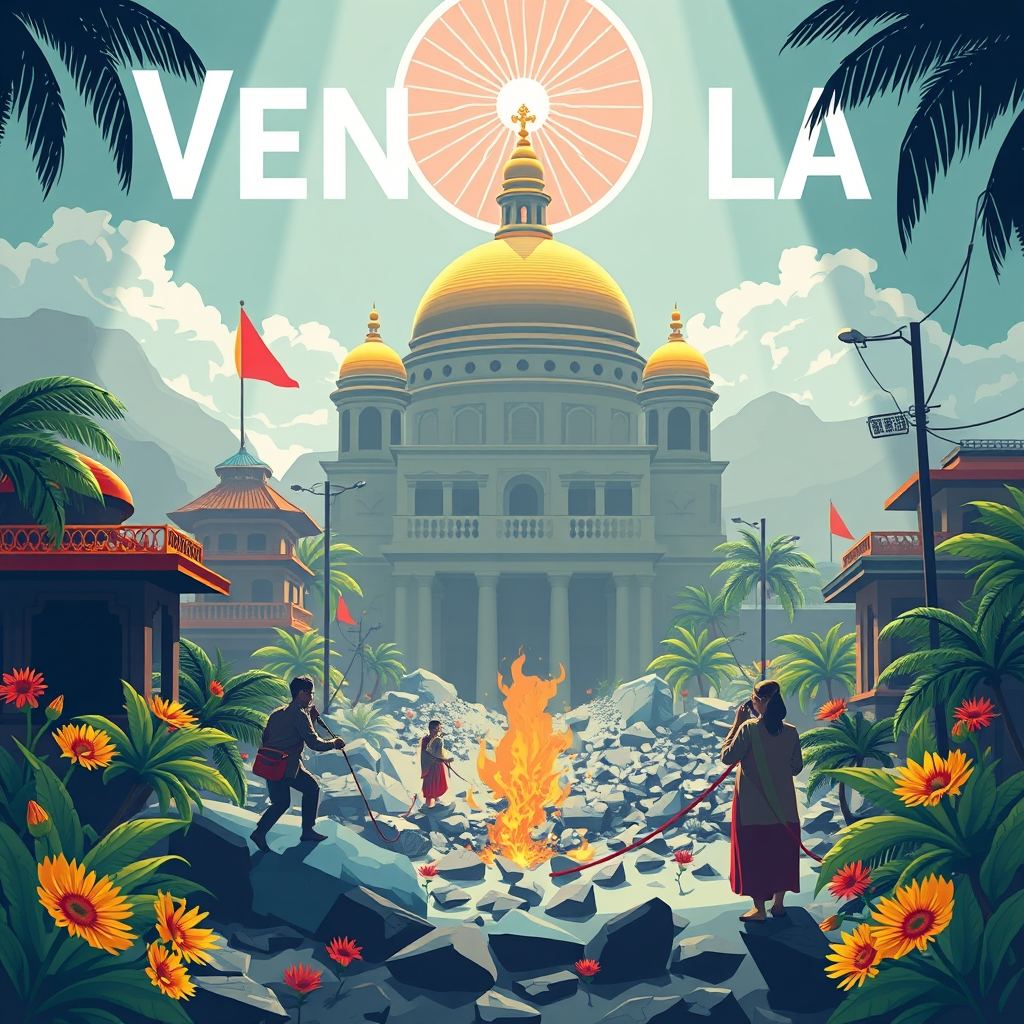
Venezuela Crisis: Earthquake Fallout Triggers Political Power Struggle
The devastating twin earthquakes in Venezuela have transcended a humanitarian catastrophe to become a critical flashpoint in the nation's leadership struggle. As the death toll surpasses 2,295, the chaos of the disaster is being leveraged by opposition leaders to challenge the legitimacy of the interim government.
A Humanitarian Disaster Becomes a Political Weapon
Following the June 24 disaster, which left over 11,000 injured and more than 36,000 people unaccounted for according to opposition databases, the political landscape in Caracas has fractured. Acting President Delcy Rodriguez, whose interim mandate expired on July 3, 2026, is facing intense scrutiny over the perceived inadequacy of the state’s relief efforts. While Rodriguez has defended her administration—claiming immediate deployment of military rescue teams and international field hospitals—residents have reported a total absence of state machinery during the critical first 48 hours of the crisis.
Nobel Peace Prize laureate Maria Corina Machado has seized this moment of instability. Speaking from Panama, Machado has positioned her potential return to Venezuela as a stabilizing force necessary to fill the "absence of the state." Her movement is already operating independently, setting up digital databases for the missing and mobilizing the Venezuelan diaspora to bypass official government channels.
The Geopolitical Tug-of-War: US Interests vs. Opposition Ambition
The crisis is further complicated by shifting dynamics in Washington. Following the January military operation that led to the ouster of Nicolas Maduro, the Trump administration has pivoted to support Delcy Rodriguez. This shift is driven by pragmatism; the U.S. has praised Rodriguez's business-friendly reforms in Venezuela’s lucrative oil sector, prioritizing economic stability and energy security over immediate democratic transition.
This has created a strategic impasse. While Machado seeks to return to lead protests and push for the democratic transition endorsed by her candidate Edmundo Gonzalez, the U.S. government has reportedly dissuaded her from returning. U.S. officials expressed concerns that her return could ignite unrest during a period of national mourning. The tension escalated when Rodriguez reportedly shut down commercial airspace into Caracas—a move Machado claims was designed specifically to prevent her return, even at the cost of delaying international relief workers.
Uncertainty Over the Executive Mandate
As of July 3, 2026, the legal status of the Venezuelan presidency remains in limbo. Rodriguez’s 180-day interim period has officially expired. Under the current constitutional framework, the National Assembly—controlled by Rodriguez’s party—holds the power to declare the presidency vacant and trigger snap elections. With the government facing a legitimacy crisis and the opposition mobilizing via digital and grassroots networks, the expiration of this mandate marks a period of extreme volatility for the South American nation.
What It Means for India
- Energy Security and Oil Markets: As the U.S. backs Rodriguez’s oil reforms, any prolonged instability or civil unrest in Venezuela could disrupt global oil supplies, potentially impacting international crude prices and India's energy import calculations.
- Diplomatic Neutrality: Venezuela’s internal struggle between a U.S.-backed interim leader and a Nobel-recognized opposition leader requires India to maintain a careful, balanced stance, prioritizing humanitarian concerns and the stability of the global energy market.
- Diaspora and Humanitarian Precedents: The use of digital databases by the opposition to manage humanitarian crises provides a modern case study in "non-state" disaster management, a phenomenon that could influence how India views technological resilience during domestic natural disasters.