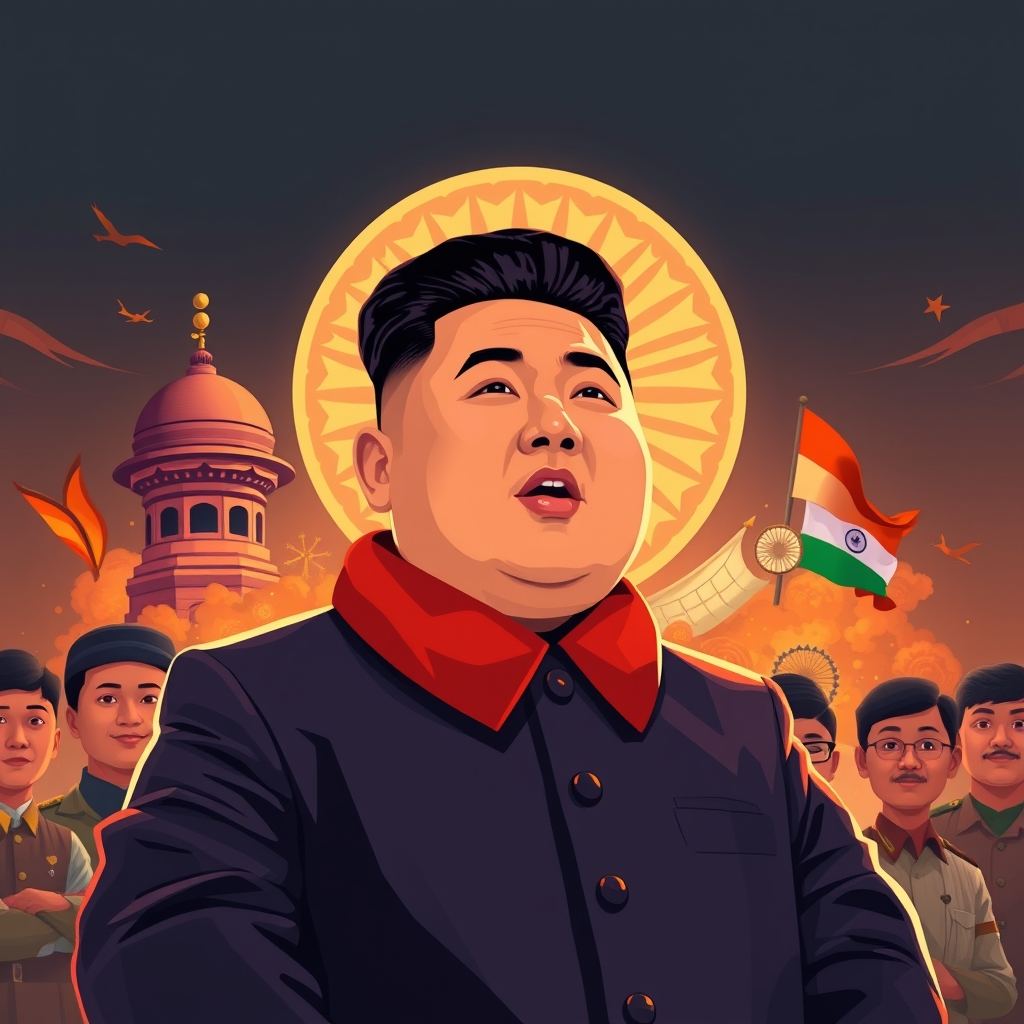
Kim Jong Un Vows to Assert North Korea’s Status as a Nuclear State
North Korean leader Kim Jong Un has signaled a hardening of Pyongyang’s nuclear stance, declaring that maintaining its nuclear arsenal is the only way to navigate an increasingly volatile global security landscape. During a recent meeting of the Workers' Party of Korea, Kim asserted that North Korea will "thoroughly exercise" its position as a nuclear weapons state to counter what he described as hegemonic aggression.
Defiance Amid Global Instability
Speaking at the second plenary meeting of the Ninth Central Committee of the Workers' Party of Korea, which concluded on Monday, June 23, 2026, Kim Jong Un blamed "hegemonic forces" for the current global unrest. He specifically pointed toward the United States, accusing Washington of fueling bloodshed in Europe and West Asia through "gangster-like" greed. This rhetoric underscores Pyongyang's intent to link its local security concerns with the broader geopolitical fractures seen in the Middle East and Eastern Europe.
The North Korean leader argued that the "unpredictable and complicated" nature of international military and political situations necessitates a strengthened nuclear posture. By framing nuclear development as a defensive necessity against global instability, Kim is attempting to justify Pyongyang's continued defiance of United Nations and U.S. sanctions that have been in place since 2006.
Escalation of Conventional and Naval Capabilities
Beyond nuclear rhetoric, the state news agency KCNA reported that Kim has ordered a significant buildup of conventional military hardware. A key development in this expansion is the accelerated construction of a 10,000-ton strategic guided missile cruiser. This move suggests that North Korea is not only focusing on its deterrent nuclear triad but is also aiming to project power through advanced naval technology.
Kim further accused the United States and South Korea of making the Korean Peninsula more dangerous by upgrading their combined nuclear posture. According to Kim, the primary objective of these joint maneuvers is to prepare for an attack on North Korea. This cyclical pattern of escalation—where North Korean advancements are met by US-ROK military drills, which in turn trigger further North Korean provocations—shows no signs of immediate de-escalation.
A Hardened Stance on Denuclearization
The latest statements from Pyongyang reinforce a long-standing reality: North Korea has officially declared itself a nuclear state and shows no intention of returning to the negotiating table for denuclearization. Despite decades of diplomatic efforts by the United States, China, and South Korea, the regime remains committed to its atomic program as a cornerstone of national survival.
While KCNA did not specify immediate tactical actions regarding the nuclear arsenal, the directive to "steadily expand and strengthen" these forces indicates a long-term strategic shift toward military self-reliance and high-tech deterrence. This evolution from a purely defensive posture to one involving strategic naval assets represents a significant change in the regional security calculus.
What It Means for India
- Regional Security Complications: As a major power in the Indo-Pacific, India must monitor the proliferation of advanced missile technology and naval capabilities in East Asia, as North Korean advancements can inadvertently influence the military-technological race in other parts of the region.
- Diplomatic Balancing Act: The hardening of North Korea’s stance complicates India's engagement with other key players like the U.S. and China, requiring New Delhi to maintain a nuanced foreign policy that prioritizes regional stability and the non-proliferation regime.
- Maritime Security Interests: The development of large-scale strategic guided missile cruisers by North Korea highlights an increasing trend of militarization in the maritime domain, which impacts the broader security architecture of the Pacific and Indian Ocean corridors.