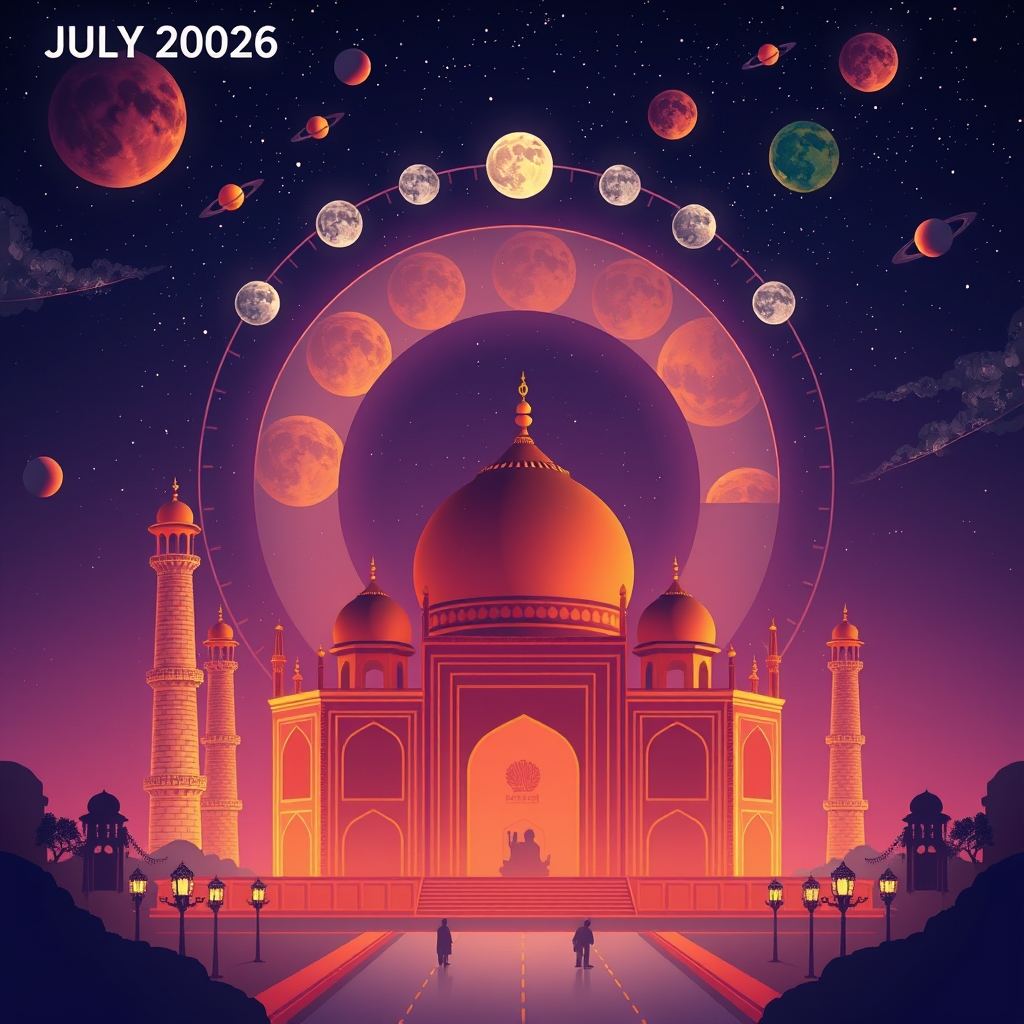
July 2026 Celestial Calendar: Major Planetary Alignments and Moon Phases
The cosmos promises a spectacular display in July 2026, offering a rich tapestry of planetary conjunctions and lunar phenomena for skywatchers. From the golden glow of Saturn to the brilliance of Venus, the month provides diverse opportunities for both amateur astronomers and casual observers to witness the mechanics of our solar system.
Early Morning Marvels: Saturn, Mars, and the Pleiades
The month begins with significant early-morning activity. On the early hours of 7 and 8 July, observers can witness a close pairing of the third-quarter Moon and Saturn in the eastern sky. Saturn, identifiable by its steady golden light, will be joined by Mars, creating a concentrated cluster of bright celestial landmarks before dawn.
A few days later, the visual complexity increases as a delicate crescent Moon aligns with Mars and the Pleiades star cluster. The Pleiades, known as the "Seven Sisters," appear as a blue-white cluster that is best viewed with binoculars. For those interested in lunar topography, this period offers excellent conditions to observe craters and mountain ranges along the lunar terminator, where the low angle of sunlight emphasizes surface details.
The Dark Sky Window: Milky Way and New Moon
One of the most strategically important dates for deep-sky observation is 14 July, which marks the New Moon. The absence of moonlight provides a rare "dark sky" window, essential for viewing faint celestial structures that are otherwise washed out by lunar glare.
During this period, the Milky Way will be most visible, particularly its bright central region located near the "Teapot" pattern in the constellation Sagittarius. For observers in India, moving away from the light pollution of urban centers like Delhi or Mumbai toward darker, rural regions will be crucial to seeing the galactic center with the naked eye.
Evening Highlights: Venus and the Buck Moon
As the month progresses, the evening sky takes center stage. In mid-July, Venus—the brightest planet in our sky—will appear in a striking conjunction with a young crescent Moon shortly after sunset. This event is highly accessible to urban observers due to Venus's extreme brightness.
The month concludes on 29 July with the arrival of the "Buck Moon," the full Moon of the month. As the Moon reaches full illumination, it will dominate the night sky, potentially creating the "Moon illusion" as it rises above the eastern horizon, making it appear much larger than its actual size.
What It Means for India
While celestial events are global, they hold specific significance for India’s growing footprint in space and science:
- Advancement of Amateur Astronomy: With India’s rapid urbanisation and increasing light pollution, these specific dates provide vital windows for the domestic astronomical community to engage in observational science.
- Scientific Inspiration: Such predictable and spectacular celestial events serve as powerful tools for the Indian government and educational bodies to foster interest in STEM (Science, Technology, Engineering, and Mathematics) among the youth.
- Support for Space Research: The ability to track and observe planetary movements reinforces the importance of high-resolution ground-based observational infrastructure, which complements India's burgeoning space capabilities led by ISRO.