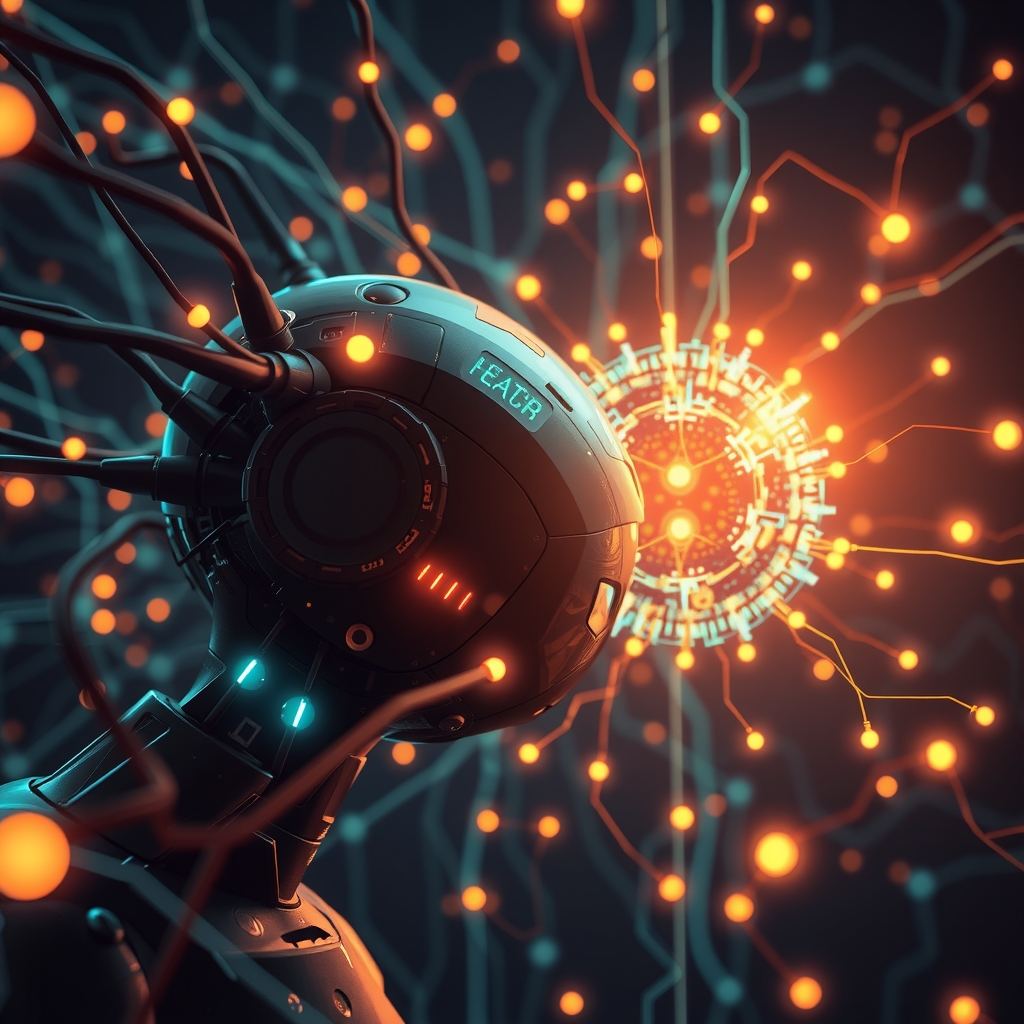
Why a digital twin of a cell matters
Drug discovery today is a gamble. Researchers spend years tweaking molecules, then test them in cells, animals and finally people. Most candidates never make it past early human trials. A reliable computational model that can forecast cellular response would let scientists discard dead-end compounds early and focus resources on the most promising leads.
Arc treats a cell as a system that can be simulated in silico, much like engineers model an aircraft before it ever leaves the ground. If the simulation reproduces the gene-expression changes a real cell would show under a given perturbation, the need for costly, time-consuming experiments shrinks dramatically.
The “State” model – a transformer trained on 100 million cells
At the heart of the platform sits a transformer-style neural network the team calls State. Transformers power large language models; here they ingest biological data instead of text. State learned from a curated set of 100 million single-cell measurements, picking up statistical relationships between genetic perturbations and downstream expression patterns.
Arc says State outperforms earlier models that relied on simpler statistical techniques. The team also admits a key limitation: when the model encounters a cell type it never saw during training, its predictions degrade. Researchers estimate that a “perfect” model—one that can generalize across all human cell types—remains about a decade away.
Putting the model to the test: the Virtual Cell Challenge
To gauge how well State and other approaches fare in realistic settings, Arc organized a public competition dubbed the Virtual Cell Challenge. Participants received a difficult dataset and were asked to predict gene-expression outcomes for unseen perturbations. The results were sobering: many AI teams performed worse than a naïve mathematical average of the training data.
The outcome underscores a broader point the field has wrestled with: pure deep-learning models, even large ones, stumble when input data are noisy, sparse, or biologically heterogeneous. Successful submissions paired neural networks with classical statistical methods, suggesting a hybrid workflow may be the near-term path forward.
Cleaning the mess: scBaseCount data pipeline
One of the biggest obstacles in building a model like State is data quality. Raw single-cell measurements are riddled with batch effects, missing values and inconsistent annotations. Arc answered by engineering a suite of AI agents that automate data curation, collectively called scBaseCount.
- Finder agents crawl public repositories and pull down raw files.
- Organizer agents standardize formats, align metadata and resolve naming conflicts.
- A supervisor agent audits the output, flagging anomalies for human review.
The pipeline has assembled a repository of roughly 500 million cells—four times larger than the previous biggest public collection. The sheer volume, coupled with systematic cleaning, gives State a richer, more reliable training ground than earlier efforts.
Learning by doing: the feedback loop
Arc does not rely solely on historical data. The platform runs an active-learning cycle: the AI proposes new experiments, the lab executes them, and the results flow back into the model. In practice, an AI agent selects a gene to knock out or a drug to apply, the experiment runs on real cells, and the observed expression changes refine State’s parameters.
This loop serves two purposes. First, it continually expands the training set with data points that hit the model’s current blind spots. Second, it provides a built-in verification step, ensuring predictions are grounded in empirical evidence rather than taken at face value.
What this means for AI engineers and biotech firms
Arc’s public disclosures boil down to two practical lessons:
- Ubora wa data unashinda utata wa modeli. Transformer ya kisasa iliyofundishwa kwa data zenye kelele na zisizokamilika itafanya vibaya kuliko algoriti rahisi inayopewa ingizo zilizochujwa kwa umakini mkubwa. Mchakato wa scBaseCount unatukumbusha kuwa kuwekeza katika uhandisi wa data kunaweza kuleta faida kubwa zaidi kuliko kukimbilia ukubwa wa modeli unaozidi kuongezeka.
- Mizunguko ya uhakiki ni muhimu. Kuamini matokeo ya modeli bila ukaguzi wa nje ni hatari, hasa katika biolojia ambapo vigezo vinavyoweza kuvuruga matokeo (confounders) ni vingi. Kuweka mawakala (agents) wanaothibitishana—au wanaolinganisha utabiri na majaribio ya ulimwengu halisi—kunatengeneza ulinzi unaozuia makosa ya kimfumo mapema.
Njia ya mbele na wenye mashaka
Ingawa ahadi ni wazi, teknolojia hii bado haijafikia hatua ya kuwa suluhisho la tayari kutumika. Ugumu wa State na aina za seli zisizojulikana unaashiria kuwa modeli bado haina uelewa wa kweli wa biolojia inayohusika. Matokeo ya Virtual Cell Challenge yanaonyesha kuwa hata timu za AI zenye ufadhili mkubwa zinaweza kushindwa na misingi rahisi (baselines) wakati tatizo linapokuwa halijajengwa vizuri.