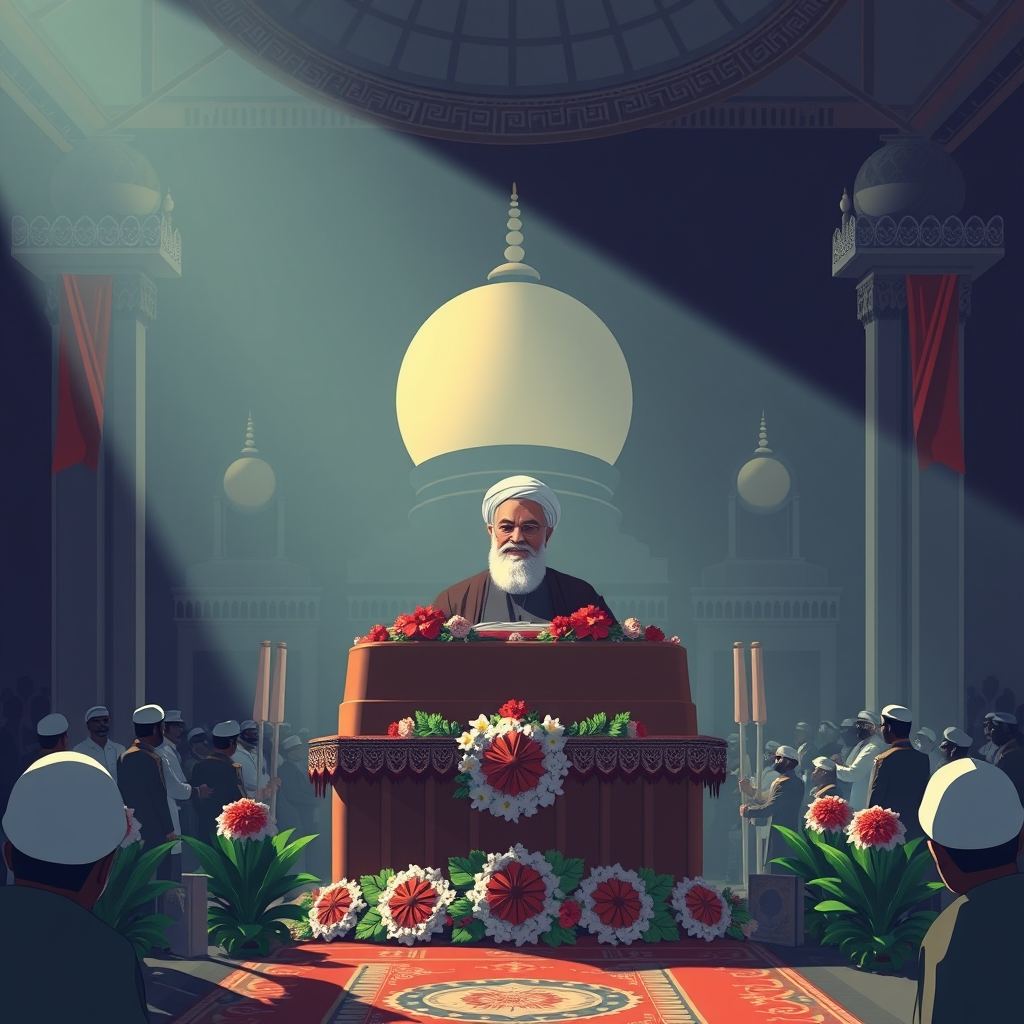
Tehran Begins State Funeral for Ayatollah Khamenei Amid Global Tension
The week-long state funeral ceremonies for Iran’s longtime Supreme Leader, Ayatollah Ali Khamenei, have commenced in Tehran, marking a pivotal moment of mourning and political transition. Following his death in US-Israeli airstrikes, the massive processions aim to project national unity and the resilience of the Islamic Republic’s revolutionary ideals.
A Display of Revolutionary Unity and Mourning
The funeral rites, which began on Friday, have seen thousands of mourners, senior clerics, and high-ranking officials gather in Tehran to pay tribute to the leader who ruled Iran for 37 years. Khamenei’s coffin, alongside that of his family members killed in the same strikes, was placed in state at the grand prayer hall built for his predecessor, Ayatollah Ruhollah Khomeini.
Symbolism played a central role in the ceremonies; a black turban, signifying descent from the Prophet Mohammed, and a chequered scarf, representing solidarity with the Palestinian cause, rested atop the bier. The scale of the event, stretching across Iran and into the Iraqi shrine cities of Najaf and Kerbala, is intended by Tehran to demonstrate that the ideological foundation of the state remains intact despite the loss of its central figure.
Geopolitical Shifts and the Role of International Dignitaries
The funeral serves as a significant diplomatic stage, highlighting the shifting alliances in the Middle East. Despite the recent US-Israeli strikes that led to Khamenei’s death, an interim US-Iran truce provided the necessary security window for these ceremonies to proceed.
The attendance of various global leaders underscores the complex geopolitical landscape. Notable attendees included former Russian President Dmitry Medvedev, Chinese National People’s Congress deputy head He Wei, and Pakistani Prime Minister Shehbaz Sharif. The presence of family members from Hezbollah leader Hassan Nasrallah and commander Imad Mughniyeh further emphasizes Iran’s deep-rooted connections with its regional "Axis of Resistance." As the remains move toward Mashhad for burial on Thursday, the involvement of regional Shi’ite allies in Iraq is expected to reinforce Iran's influence over the "Shi'ite Crescent."
Security Measures and the Path Ahead
Tehran remains under heavy security, with the Basij volunteer force and military personnel patrolling major thoroughfares to prevent any disruptions. Iranian authorities have issued stern warnings to the United States and Israel against conducting further strikes during the mourning period.
The transition of power is already underway, evidenced by the presence of newly appointed Revolutionary Guards chief Ahmad Vahidi among the mourners. As the nation prepares for the final burial near the shrine of Imam Reza, the central question remains whether the interim truce with the US will hold or if the vacuum left by Khamenei will trigger a renewed escalation in regional hostilities.
What It Means for India
- Navigational Complexity in West Asia: The sudden leadership vacuum in Iran and the delicate truce with the US will require India to exercise high-level diplomacy to protect its strategic interests and ensure the stability of energy corridors.
- Impact on Diaspora and Energy Security: Any potential escalation in regional tensions following the funeral could impact the safety of the Indian diaspora in the Gulf and create volatility in global oil prices, a critical concern for India's economy.
- Balancing Strategic Autonomy: As major powers like Russia and China participate heavily in the mourning process, India will need to balance its "strategic autonomy" by engaging with the new Iranian leadership while maintaining its growing security and technological partnerships with the West.