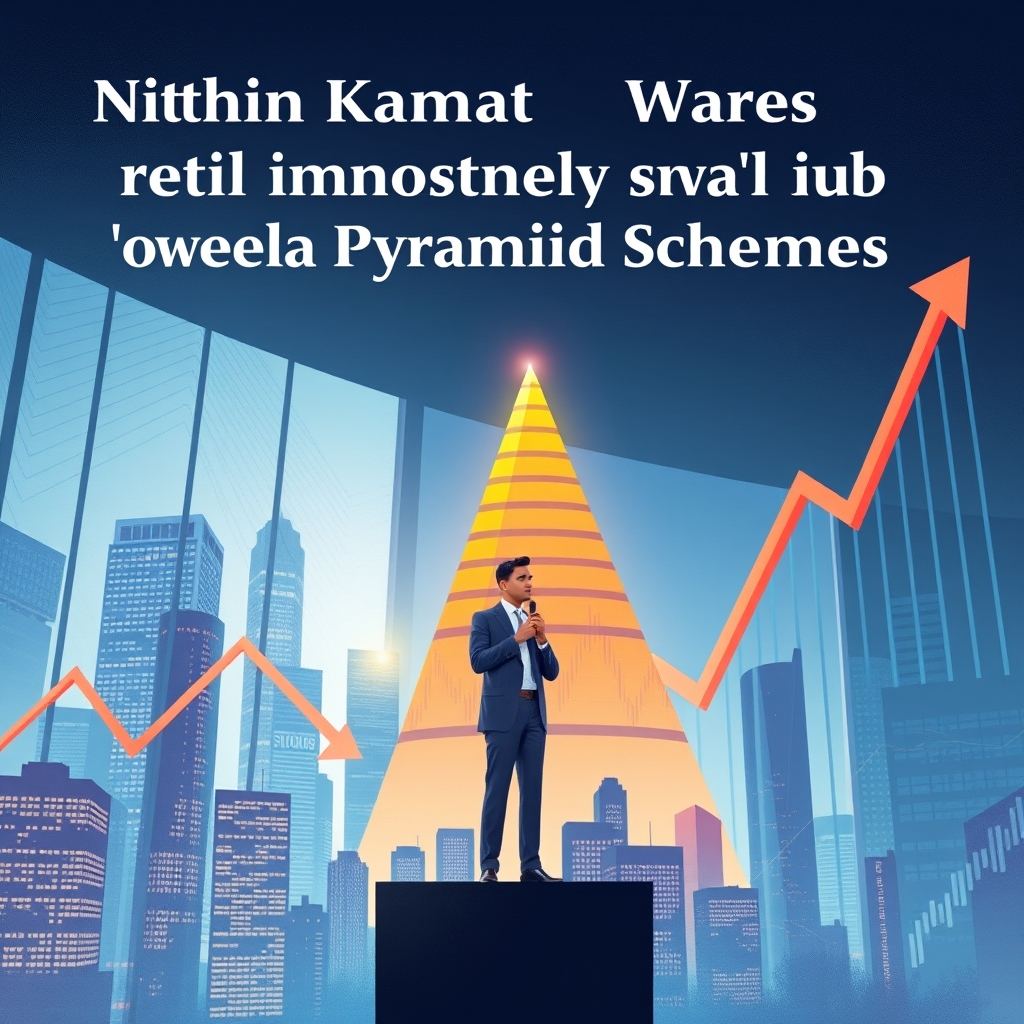
Nithin Kamath Warns Retail Investors Against 'Easy Money' and Pyramid Schemes
Zerodha co-founder Nithin Kamath recently shared a personal cautionary tale about falling victim to a multi-level marketing (MLM) scam in his youth. His experience serves as a stark warning to modern retail investors who are often lured by the promise of quick, effortless wealth in the financial markets.
A Personal Lesson in Financial Deception
Reflecting on his journey, Kamath revealed that at the age of 18, while attempting to fund his trading account, he spent nearly two years involved with an MLM company that ultimately proved to be a pyramid scheme. He noted that while the individual who introduced him may not have had malicious intent, the corporate structure itself was designed to deceive.
Kamath admitted to a common pitfall: he had even introduced others to the scheme before its eventual collapse. This personal vulnerability highlights how even those who eventually master the markets can be deceived by the psychological pull of "fast money" when starting out.
The Massive Scale of Pyramid Schemes in India
Despite increasing financial literacy, Kamath highlighted the alarming persistence of fraudulent schemes in India. He cited staggering industry estimates to illustrate the magnitude of the problem:
- Frequency: Approximately two new pyramid schemes are launched every single day in the country.
- Impact: As of 2015, over 5.5 crore Indians had lost their savings to more than 5,300 such schemes.
- Financial Loss: The estimated losses reached ₹10 lakh crore by 2015, a figure Kamath believes is significantly higher in the current economic landscape.
The Peril of 'Easy Money' in Modern Equity Markets
Kamath linked the mechanics of pyramid schemes to a dangerous trend in the current retail stock market boom. He observed that the surge in market participation has created a false narrative that making money from equities is easy.
He cautioned that the "easy money" rhetoric being spread among retail investors is a precursor to financial disaster. "The reckoning tends to come quietly, one account at a time," he warned, emphasizing that any return promised significantly higher than a standard bank Fixed Deposit (FD) carries exponentially higher risk.
His advice to investors is simple: if a scheme relies heavily on referral-based earnings—where you make money primarily by introducing others—it is almost certainly a fraud. In the world of legitimate investing and trading, there are no shortcuts to building sustainable wealth.
Key Takeaways
- Beware of High Returns: Any investment promising returns far exceeding bank FDs should be viewed with extreme skepticism, as higher claims always equate to higher risks.
- Avoid Referral-Based Models: If the primary way to earn money is by recruiting new participants, it is likely a fraudulent pyramid scheme.
- Market Realism is Vital: Retail investors must resist the social media narrative that equity trading is "easy money" to avoid significant capital erosion.