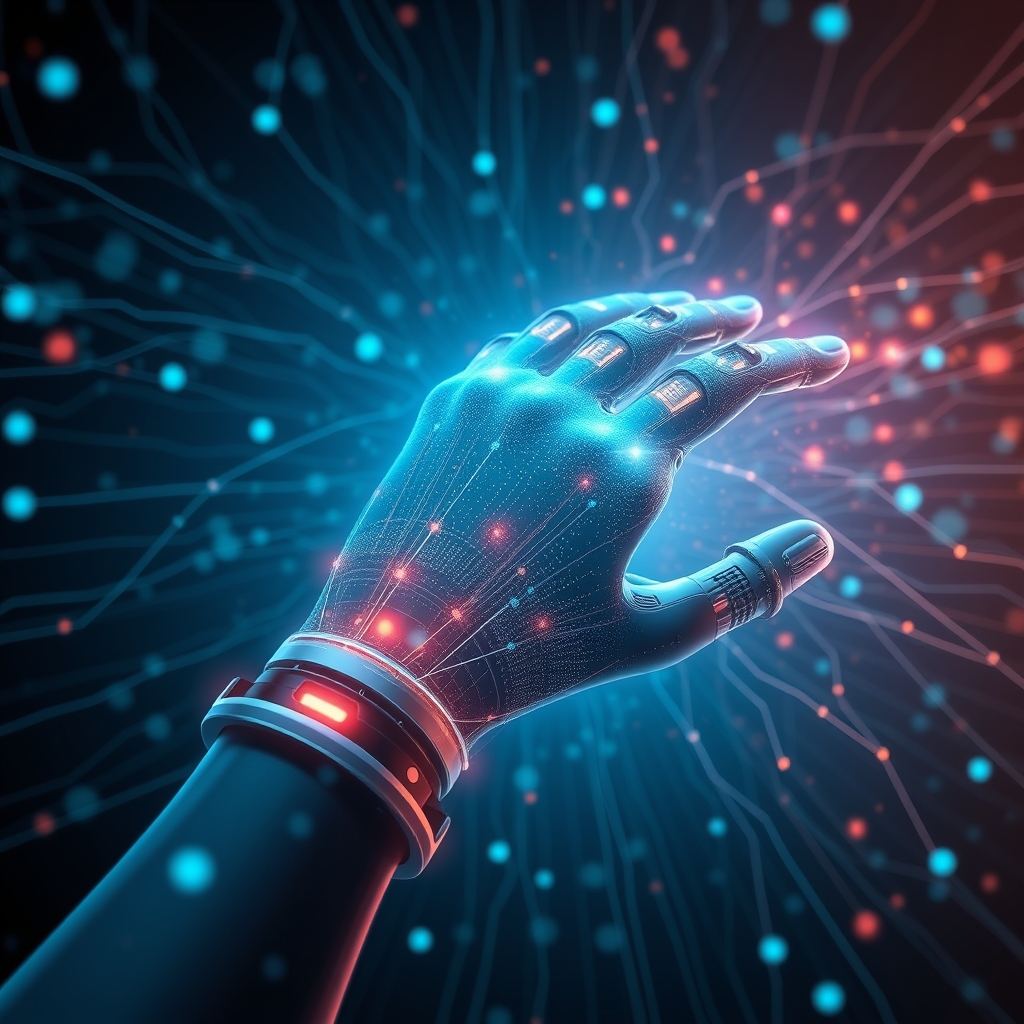
Ultrasound-Powered Wristband Enables Precise Robotic Hand Mimicry
Researchers have unlocked a new frontier in human-robot interaction by using ultrasound imaging to translate internal muscle movements into digital commands. This breakthrough allows for unprecedented dexterity, enabling robotic hands to mimic human gestures with the nuance of a marionette.
Decoding the "Puppet Strings" of Human Dexterity
The human hand is a marvel of biological engineering, utilizing 34 muscles, 27 joints, and over 100 tendons and ligaments to achieve complex movements. For years, engineers have struggled to replicate this dexterity in robots because traditional sensors often fail to capture the intricate internal mechanics happening beneath the skin.
To solve this, a research team led by MIT’s Mechanical Engineering professor Xuanhe Zhao, alongside colleagues from the University of Southern California, has developed a wearable ultrasound wristband. The device utilizes a miniaturized ultrasound "sticker"—a scaled-down version of medical-grade transducers—paired with a specialized hydrogel for skin adhesion. By imaging the wrist's internal structures, the device treats tendons and muscles like the strings of a puppet, where the state of the "strings" reveals the exact position of the fingers and palm.
AI-Driven Real-Time Motion Translation
The core of this technology lies in its sophisticated AI integration. The system employs an artificial intelligence algorithm that has been trained on a vast dataset of ultrasound images meticulously labeled by humans. As the wearer moves their hand, the ultrasound device captures real-time imagery of the wrist's internal anatomy, which the AI instantly translates into precise finger and palm coordinates.
In experimental demonstrations, this wireless control has proven remarkably capable. Users have successfully commanded robotic hands to perform high-precision tasks, such as playing a simple tune on a piano or shooting a miniature basketball into a hoop. Beyond physical robotics, the technology extends to digital environments, allowing users to manipulate virtual objects—such as pinching to zoom on a computer screen—with natural hand gestures.
Scaling for Surgery and Humanoid Robotics
While the current hardware is approximately the size of a smartphone, the research team is focused on further miniaturization and expanding the diversity of their AI training sets. By incorporating a wider variety of hand sizes, finger shapes, and complex gestures, the researchers aim to create a universal standard for hand tracking.
The implications for the broader AI and robotics landscape are profound. One of the most significant goals is the creation of a massive, high-fidelity dataset of human hand motions. This data could be used to train humanoid robots to perform delicate, high-stakes tasks, such as robotic-assisted surgical procedures, where even a millimeter of error is unacceptable. As we move toward a future of seamless human-machine collaboration, wearable imaging may become the primary interface for controlling the next generation of dexterous machines.
Key Takeaways
- Internal Motion Capture: Unlike surface-level sensors, ultrasound imaging tracks the actual movement of tendons and muscles to provide superior dexterity.
- AI Translation: An advanced algorithm converts real-time ultrasound imagery into precise digital commands for both robotic hardware and virtual interfaces.
- High-Stakes Applications: The technology paves the way for training humanoid robots in delicate tasks, including precision surgery and complex manual labor.