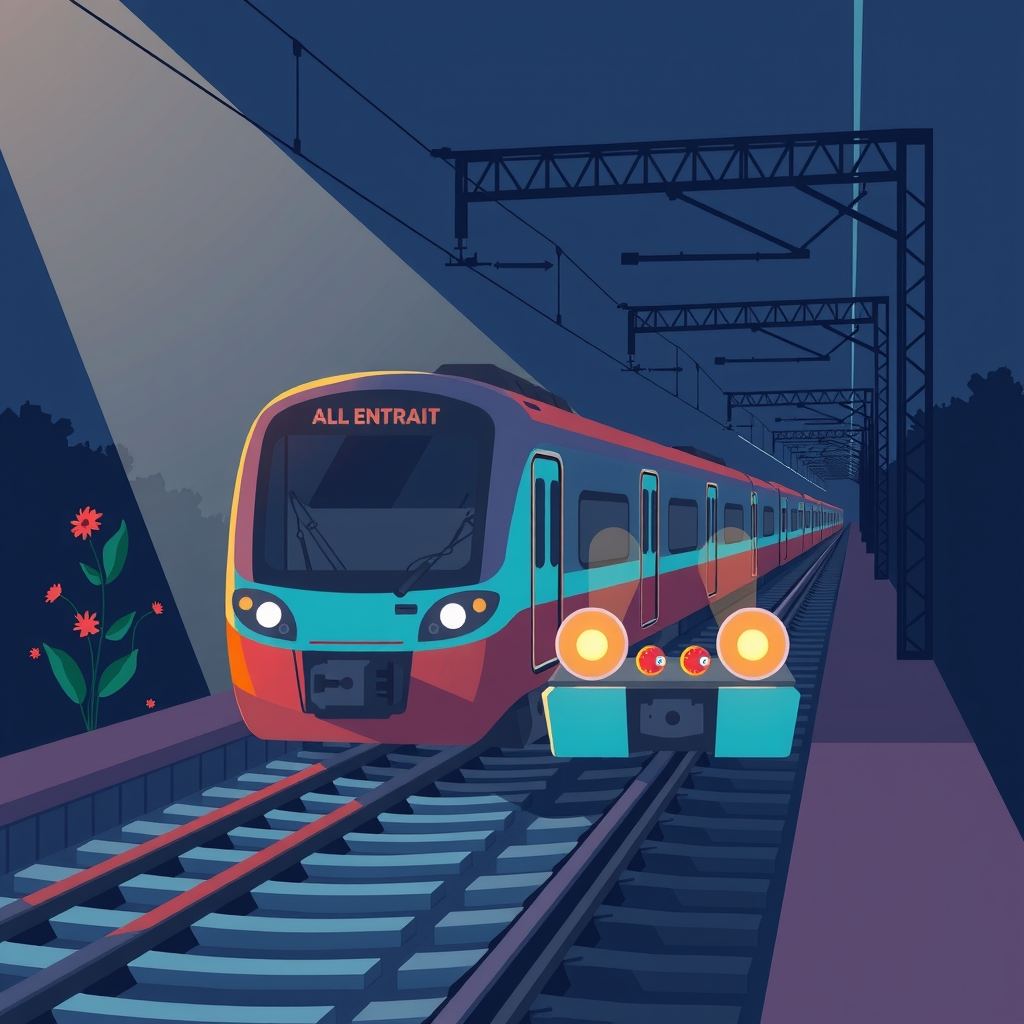
A train traveling between Rouen and Caen derailed near the town of Cleon on Friday evening. Forty-four of the 180 passengers were injured, and a helicopter rescued a victim in critical condition. Emergency crews sent 140 firefighters to the scene.
French authorities say the train struck an unidentified object on the tracks; the cause remains under investigation. SNCF halted service on the Rouen-Caen and Caen-Le Havre lines and deployed replacement buses.
Why AI-driven monitoring matters
Rail networks depend on a clean track bed, yet foreign-object debris—fallen cargo, stray vehicles, even branches—can appear without warning. Traditional inspections rely on scheduled human walks, visual checks from inspection trains, or fixed cameras that record video for later review. Those methods miss transient hazards or spot them only after a train has passed.
AI systems process sensor data in real time and flag anomalies the moment they appear. A typical deployment mounts high-resolution lidar or radar scanners on trackside posts or moving inspection vehicles and feeds the feed to computer-vision models trained to recognize shapes that don’t belong on a railway. When the algorithm spots an out-of-place object, it sends an alert to the control centre, slows or stops approaching trains, and dispatches maintenance crews to the exact GPS coordinate.
If such a system had been active on the Normandy line, the obstacle that forced the train off the rails could have been identified minutes—or seconds—before the train arrived, giving operators a chance to intervene.
The broader context
Europe’s railways are under pressure to move more passengers and freight as governments push for greener transport. France, with one of the continent’s most extensive high-speed and regional networks, markets safety as a core public-service value. Incidents like the Cleon derailment expose a vulnerability that technology could mitigate.
Rail operators worldwide are already testing AI-enabled monitoring. In several Asian countries, pilots use drone-based aerial surveys that feed video into neural-network classifiers, producing live maps of track conditions. In the United States, freight railroads have installed wayside lidar that continuously scans for track-side intrusions and links to automated braking systems.
Early lidar-based obstacle-detection kits cost several hundred thousand euros per kilometre. Recent advances in sensor miniaturisation and cloud-based model serving have driven that price down dramatically—a cost many operators can amortise over a few years given the avoided expenses of accidents, service disruptions, and liability claims.
Who gains, who bears the risk
Rail operators could cut accident-related downtime and protect their reputation. Savings would come from fewer emergency repairs, lower insurance premiums, and more reliable schedules.
Passengers would enjoy smoother, safer journeys. The 44 injuries and one critical case in Normandy might have been avoided, sparing lives and trauma.
Governments and regulators would gain clearer compliance evidence. AI monitoring can generate audit trails that demonstrate proactive safety management, simplifying the path to meet national and European directives.
Technology providers stand to tap a market worth billions of euros across Europe, Asia, and North America as operators shift from manual inspection regimes to AI platforms.
Adoption is not frictionless. Continuous video streams raise data-privacy concerns, potentially capturing people on adjacent properties. Algorithmic bias can trigger false positives, causing unnecessary service interruptions that erode passenger confidence. Integration complexity forces legacy signalling systems to be retrofitted for real-time hazard inputs without compromising existing safety interlocks.
What the French investigation reveals
SNCF and French police will examine whether the object resulted from vandalism, a fallen cargo container, or a maintenance lapse. If investigators find the object entered the track corridor through an unsecured access point, the case will highlight the need for better perimeter security in addition to detection. If the object was a transient natural hazard—like a fallen branch—AI sensors that differentiate static infrastructure from moving debris would have been especially valuable.
Het opschorten van de diensten tussen Rouen-Caen en Caen-Le Havre laat zien hoe een enkel incident door een regionaal netwerk resoneert, waardoor forenzen worden gedwongen over te stappen op tragere bussen en het lokale wegverkeer onder druk komt te staan. Door gevaren vooraf te verwijderen, kan AI-monitoring deze vitale aders openhouden en de economische stroom waar het spoor de basis voor vormt, waarborgen.
Tegenargument: Technologie is geen wondermiddel
Critici waarschuwen dat een te grote afhankelijkheid van AI kan leiden tot zelfgenoegzaamheid bij menselijke operators. Een systeem dat een object signaleert maar het verkeerd classificeert, kan worden genegeerd als operators gewend raken aan frequente valse alarmen. AI-modellen hebben ook grote, hoogwaardige datasets nodig om betrouwbaar te presteren; het verzamelen van dergelijke gegevens over duizenden kilometers spoor is een logistieke uitdaging.
Kosten versus risico is een ander debat. Voor regionale lijnen met weinig verkeer is de investering in geavanceerde lidar-arrays en edge-computing hardware mogelijk niet gerechtvaardigd wanneer de statistische waarschijnlijkheid van een gevaarlijk object laag is. In die gevallen zou een hybride aanpak — verbeterde periodieke inspecties gecombineerd met incidentele AI-gestuurde scans — een betere balans kunnen bieden.
Vooruitblik: Waar op te letten
- Regelgevende kaders: De Europese Unie zal naar verwachting bijgewerkte veiligheidsrichtlijnen uitgeven die AI-gebaseerde obstakeldetectie verplicht kunnen maken voor nieuwe spoorwegprojecten. Operators zullen hun inkoop- en certificeringsprocessen hierop moeten afstemmen.
- Standaardisatie van dataformaten: Interoperabiliteit tussen sensorenleveranciers, AI-modelproviders en spoorwegbeveiligingssystemen zal cruciaal zijn. Brancheorganisaties werken aan gemeenschappelijke interfaces om vendor lock-in te voorkomen.
- Pilot-uitrol: Verschillende Europese corridors hebben pilotprogramma's aangekondigd voor het begin van volgend jaar, met als doel de nauwkeurigheid van AI-detectie te valideren onder verschillende weers- en lichtomstandigheden.
- Kosten-batenstudies: Onafhankelijke beoordelingen die de langetermijnbesparingen door vermeden incidenten vergelijken met de initiële kapitaalinvesteringen, zullen de besluitvorming voor zowel drukke als landelijke netwerken sturen.
Conclusie
De ontsporing in Normandië laat zien hoe één enkel, niet-geïdentificeerd obstakel een routineuze regionale dienst kan veranderen in een crisis die tientallen mensen verwondt en een belangrijke transportcorridor platlegt. AI-gestuurde spoorwegmonitoring en obstakeldetectiesystemen beloven dergelijke gevaren te spotten voordat een trein ze bereikt, wat potentieel levens kan redden, dienstregelingen intact houdt en de economische levensaders die het spoor biedt, beschermt. Technologie alleen kan niet alle risico's elimineren, maar het integreren van real-time AI-surveillance in bestaande veiligheidsprotocollen zou de beslissende stap kunnen zijn die voorkomt dat het volgende "niet-geïdentificeerde object" een krantenkop wordt.