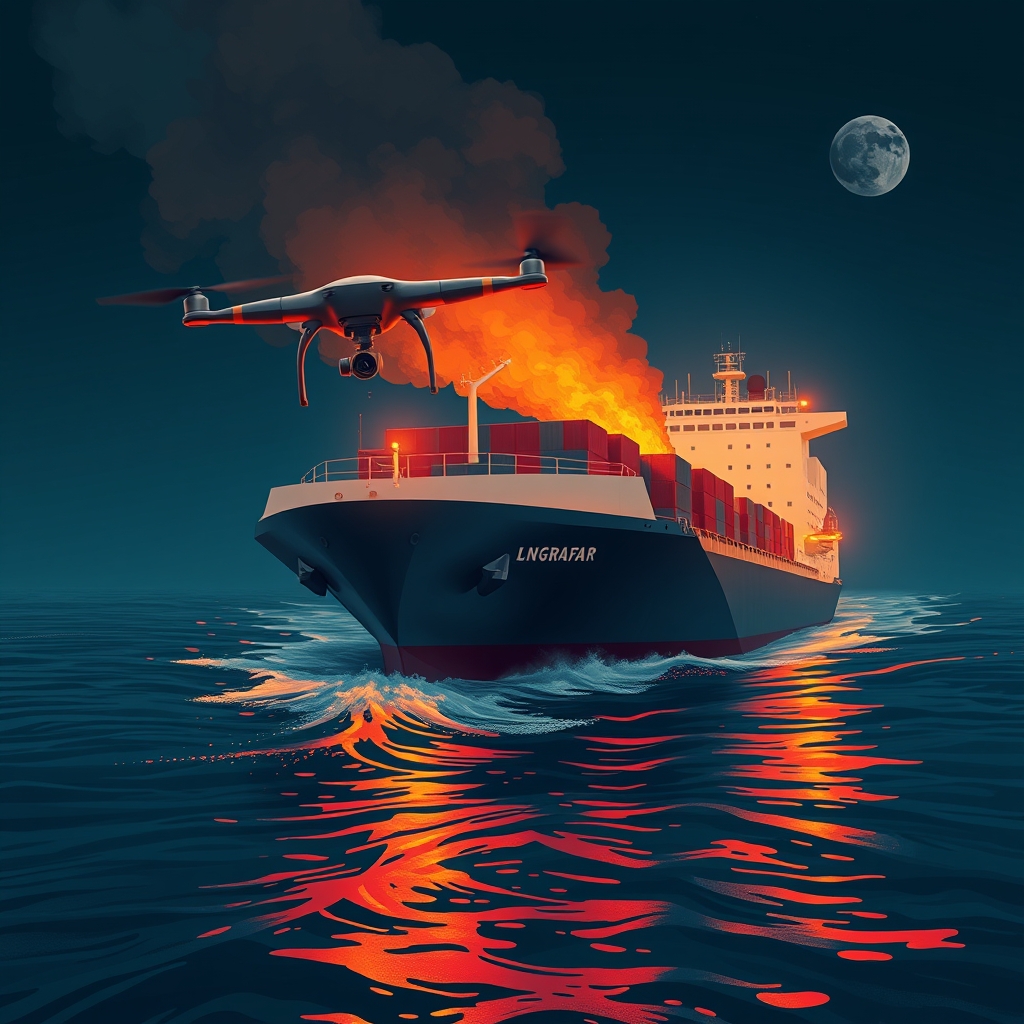
A drone strike hit the U.S.-owned floating storage and regasification unit (FSRU) Energos Winter while it sat in Egypt’s Mediterranean port of Damietta, sparking a fire that leapt to the nearby Gaslog Salem.
How the attack unfolded
British maritime-security firms Ambrey and Vanguard say an unidentified projectile—most likely a drone—hit the starboard side of the Energos Winter. The FSRU, which can store 138,250 cubic metres of LNG, ignited and the blaze spread to the adjacent Gaslog Salem. Egypt’s Petroleum Ministry confirmed a fire at the port and said Petroleum Minister Karim Badawi personally coordinated the emergency response, but it has not officially called the incident a drone strike. Ship-tracking data and multiple security sources verify the vessels involved. Fire-fighting crews contained the flames; no fatalities or injuries were reported.
The broader regional backdrop
The attack arrives as security across the Middle East unravels. Weeks earlier, Iran launched missile strikes against U.S. forces in Jordan; the United States and Saudi Arabia retaliated against Iran-backed militias in Iraq. At the same time, Yemen’s Houthi rebels announced a naval blockade of Saudi waters, and former President Donald Trump warned of possible retaliation against Tehran. These high-intensity exchanges have pushed conflict from land into the maritime arteries that move oil and gas.
Why a floating LNG tank matters
An FSRU like the Energos Winter is a mobile LNG import terminal. It receives liquefied gas from producers, stores it, and regasifies it on-site for injection into regional pipelines. Because it can dock at ports without on-shore infrastructure, an FSRU lets a country import gas quickly and at lower capital cost. Targeting such “soft” infrastructure lets an adversary inflict outsized economic pain without a conventional navy. A successful strike can halt gas deliveries, push spot prices higher, and force downstream users to seek costlier alternatives.
Ripple effects on global gas markets
The Mediterranean route supplies a sizeable share of Europe’s LNG imports and serves as a transit corridor for cargo bound for South Asia.
What India stands to lose
- Maritime-security exposure: The incident shows commercial shipping’s vulnerability to low-cost, high-impact drone attacks. Indian vessels in the western Indian Ocean and the Red Sea may face similar threats, prompting a need for stronger naval escort and surveillance.
- Diplomatic tightrope: India’s “Link West” policy balances ties with Western powers and Gulf states. Heightened tensions could pressure New Delhi to pick a side, risking strain with one or the other while it seeks uninterrupted energy flows.
Counter-argument: the incident may be isolated
Not all analysts view the Damietta strike as a turning point. Some note that the Ministry of Petroleum has not formally blamed a drone, leaving open the possibility of an accidental explosion or mechanical failure.
What to watch next
- Attribution and motive: Confirmation of the weapon used and the group behind it will shape diplomatic responses and any retaliation.
- Regional naval posture: An increase in patrols or convoy escorts in the eastern Mediterranean and Red Sea would signal that states see the threat as systemic.
- India’s policy moves: New maritime-surveillance initiatives or shifts in LNG procurement strategy will reveal how New Delhi adapts to the heightened risk.
The Damietta drone strike reminds us that energy infrastructure, even floating on calm seas, can become a battlefield. For India, whose growth depends on affordable gas, the episode adds a new variable to an already complex security equation. The next few weeks will show whether this flash of violence reshapes supply routes—or simply burns out as an isolated incident.