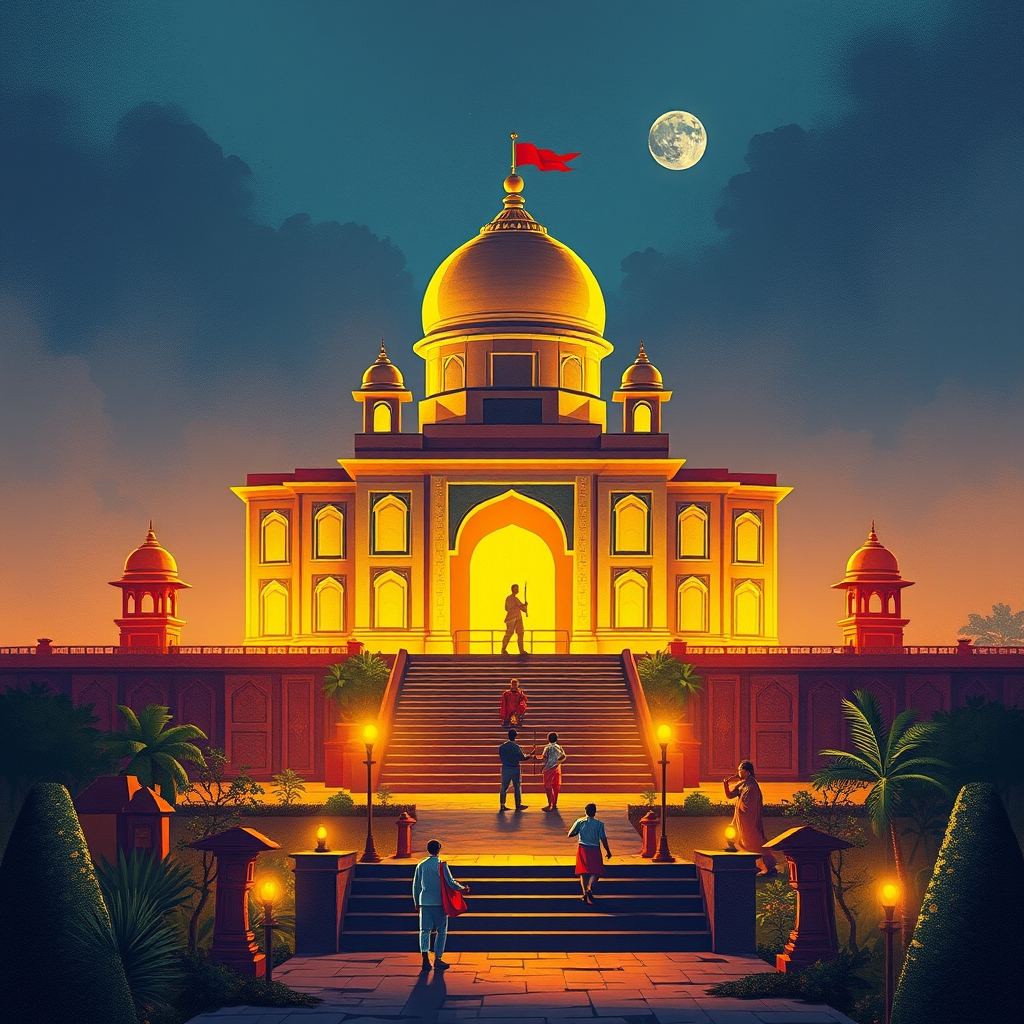
The Supreme Court has issued a fresh directive in the protracted dispute over the Bhojshala site, ordering that the open space adjacent to the monument be made available to the Muslim community specifically for Friday prayers. The ruling does not resolve the underlying ownership and worship rights claims, but it inserts a practical buffer aimed at keeping the peace while the larger case remains active.
The Bhojshala Dispute
Bhojshala is an Archaeological Survey of India-protected monument in Dhar, Madhya Pradesh. Its history is layered and contested. Many Hindus revere the site as a temple dedicated to Goddess Saraswati, traditionally linked to the Paramara king Raja Bhoj. Many Muslims regard the same complex as the Kamal Maula mosque. Because both faith communities attach deep religious significance to the location, the site has been at the center of litigation and administrative wrangling for generations.
The ASI currently oversees the property. Over the years, various court orders and government notifications have attempted to regulate who may pray, when, and in which portion of the complex. Tensions tend to spike around specific prayer days and festival seasons, when congregations swell and the physical limits of the compound become a flashpoint. The result is a situation that requires not just a historical verdict, but constant, hands-on management.
What the Latest Order Says
In its new order, the Supreme Court has directed that the Muslim side be permitted to use the open ground next to the Bhojshala structure for Friday prayers. This is a spatial compromise. It allows congregational worship to take place without direct contention over the interiors of the disputed building itself, at least for the weekly gathering that draws the largest number of worshippers.
Friday prayers, or Jumu’ah, differ from daily prayers in scale and format. They typically involve a formal sermon and a collective ritual that demands sufficient room for rows of worshippers, separate ablution areas, and safe ingress and egress. Providing an adjacent open plot acknowledges this functional reality. The court appears to be treating the open area as a temporary but necessary extension of religious space until the broader dispute reaches a final resolution.
Why Adjacent Space Matters
Anyone who has managed a crowded heritage site knows that square footage is never just square footage. At disputed religious locations, every doorway and courtyard carries symbolic weight. By earmarking the open space rather than the built structure, the court achieves several practical goals at once.
First, it preserves the physical integrity of the monument. The ASI’s conservation mandate restricts permanent alterations, heavy foot traffic on fragile surfaces, and the installation of fixtures inside protected zones. An open-air prayer arrangement on adjacent land sidesteps many of these conservation red lines. Worshippers can lay temporary mats or erect light shade structures without drilling into centuries-old stone or altering the silhouette of a protected building.
Second, security logistics become simpler. Local police and district administration can cordon off a designated field, install temporary metal detectors, manage crowd queues, and keep emergency vehicle access clear far more easily in an open plot than inside a narrow heritage corridor. If rain or extreme heat strikes, contingency planning for an outdoor gathering is straightforward: the administration can adjust timings or erect permitted tents without disturbing heritage fabric.
Third, and perhaps most importantly, the arrangement gives both communities a visible boundary. Ambiguity breeds conflict. A clear line between the monument proper and the prayer ground reduces the chance of inadvertent trespass or perceived encroachment.
Implementation on the Ground
Court orders on paper mean little without cooperation from local officials. The district magistrate’s office, the police, the ASI, and elected local committees will now need to coordinate a weekly schedule. They must decide precisely where the open space begins and ends, who cleans it after prayers, where worshippers perform wudu, and how loudspeakers or other sound equipment will be regulated. Water and sanitation facilities will need attention. Overflow crowds during Ramadan or on important Fridays could strain the space, so crowd-capacity planning is essential.
Local stakeholders also need to ensure that the Friday prayer arrangement does not become a trigger for competitive demands. The Hindu side will watch whether the open space expands in practice beyond what the court intended. The Muslim side will monitor whether access is truly unimpeded. Both communities have a stake in making the order work, because any breakdown in the weekly routine will likely land back before the Supreme Court and harden positions further.
Reading Between the Lines
The Supreme Court’s intervention here is best understood as case management rather than case closure. By addressing the immediate need for Friday prayer space outside the main disputed structure, the bench is preventing the daily friction that can escalate into violence. Indian courts have taken similar pragmatic steps before at other contested sites, prioritizing public order and safety while the substantive arguments on title, archaeology, and historical usage remain pending.
This approach carries risk. Interim arrangements sometimes calcify into permanent expectations. If the open ground is used uninterrupted for years, either side might later argue that the status quo should not be disturbed. On the other hand, without such an interim fix, the site could become ungovernable long before a final judgment arrives.
The order also signals that the court views religious practice and heritage protection as compatible goals, provided the logistics are handled with precision. It is not asking the ASI to surrender control of the monument. It is not granting exclusive possession. It is simply allocating a specific resource, an adjacent plot, for a specific purpose, at a specific time.
The Road Ahead
The Bhojshala matter is still alive and deeply contested. The Supreme Court will eventually have to grapple with the core questions: the archaeological record, the historical texts, the documentary evidence of worship patterns, and the constitutional balance between religious freedom and heritage conservation. That process will take time.
Until then, the success of this directive hinges on local compliance. The administration in Dhar must resist the temptation to improvise beyond the court’s instructions. Both communities would do well to treat the open-space arrangement not as a zero-sum victory, but as a temporary protocol designed to prevent harm to life, property, and the monument itself.
Source: India TV News
Join the GyaanSetu community: t.me/GyaanSetuBharat