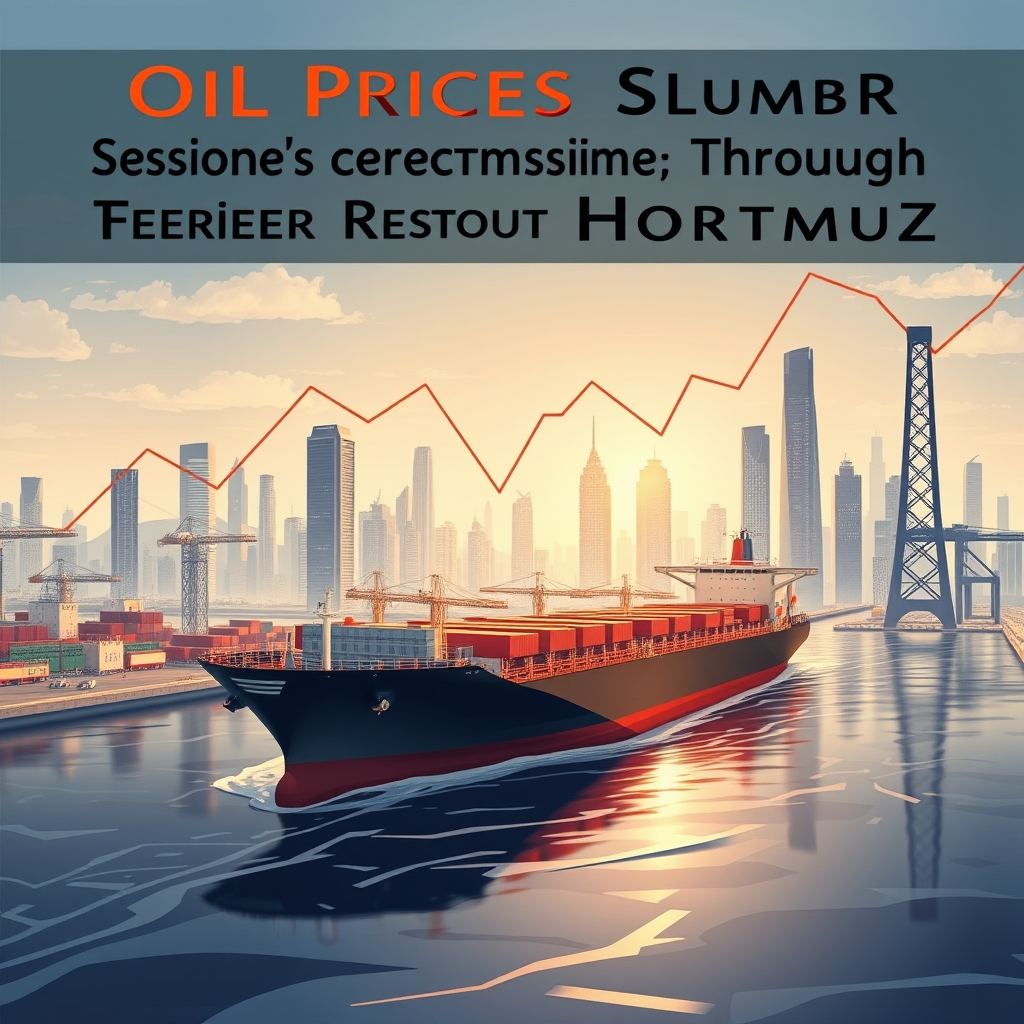
Oil Prices Slump as Tankers Resume Flow Through Strait of Hormuz
Global oil markets are witnessing a significant downward trend as supply fears ease following a breakthrough in Middle Eastern geopolitics. The movement of stranded tankers out of the Strait of Hormuz is driving prices closer to pre-war levels, catching many market analysts by surprise.
Geopolitical De-escalation Drives Price Decline
The primary catalyst for the recent price drop is the initial accord aimed at ending the U.S.-Israeli war with Iran, which commenced on February 28. This agreement has paved the way for a restart in maritime traffic through the Strait of Hormuz, a critical global chokepoint. While the accord initiates a 60-day negotiation period to address complex issues like Iran's nuclear program, its immediate impact has been to stabilize the perceived risk to global energy supplies.
As a result of this easing tension, Brent crude futures for August delivery fell by 40 cents (0.54%) to $73.34 a barrel. Similarly, U.S. West Texas Intermediate (WTI) saw a decline of 27 cents (0.38%), settling at $70.07 a barrel. Notably, August Brent is trading lower than September Brent ($73.59), a market signal indicating that there is ample short-term supply available.
Surge in Tanker Traffic and Supply Normalization
The scale of the recovery in oil flows is substantial. U.S. Energy Secretary Chris Wright reported that at least 20 million barrels of oil exited the Strait of Hormuz within a single 24-hour period. He noted that current flows are approaching levels seen before the conflict began.
To facilitate this movement, Oman has opened temporary routes to assist tanker departures, coordinated by the International Maritime Organization and Omani authorities. While a full return to normalcy may take several weeks due to the necessity of demining the strait, Wright emphasized that oil will continue to flow even if the current deal falters, asserting that Iran would be unable to close the waterway again.
Market Reaction to Inventory Data
Interestingly, the relief in oil prices is occurring despite significant data from the United States. The Energy Information Administration (EIA) recently reported that U.S. total crude stocks have plummeted to their lowest levels since 1984. This historic low is attributed to robust refining demand and the strategic release of oil from the government's emergency reserve.
However, the market appears largely unfazed by these low inventory levels. Traders are prioritizing the geopolitical stabilization of the Middle East and the resumption of tanker movements through the Strait of Hormuz over domestic U.S. stock figures. As IG analyst Tony Sycamore noted, the speed of this price decline has caught many off guard, as the market is pricing in a much faster return of Middle Eastern barrels than was anticipated just two weeks ago.
Key Takeaways
- Supply Surge: Over 20 million barrels of oil exited the Strait of Hormuz in a 24-hour window following the initial peace accord.
- Price Trend: Brent crude and WTI are both trending lower as the market signals ample short-term supply through backwardation in Brent futures.
- Geopolitical Shift: While demining efforts are required for complete normalcy, the ability of Iran to close the Strait of Hormuz is now viewed as highly unlikely by U.S. officials.