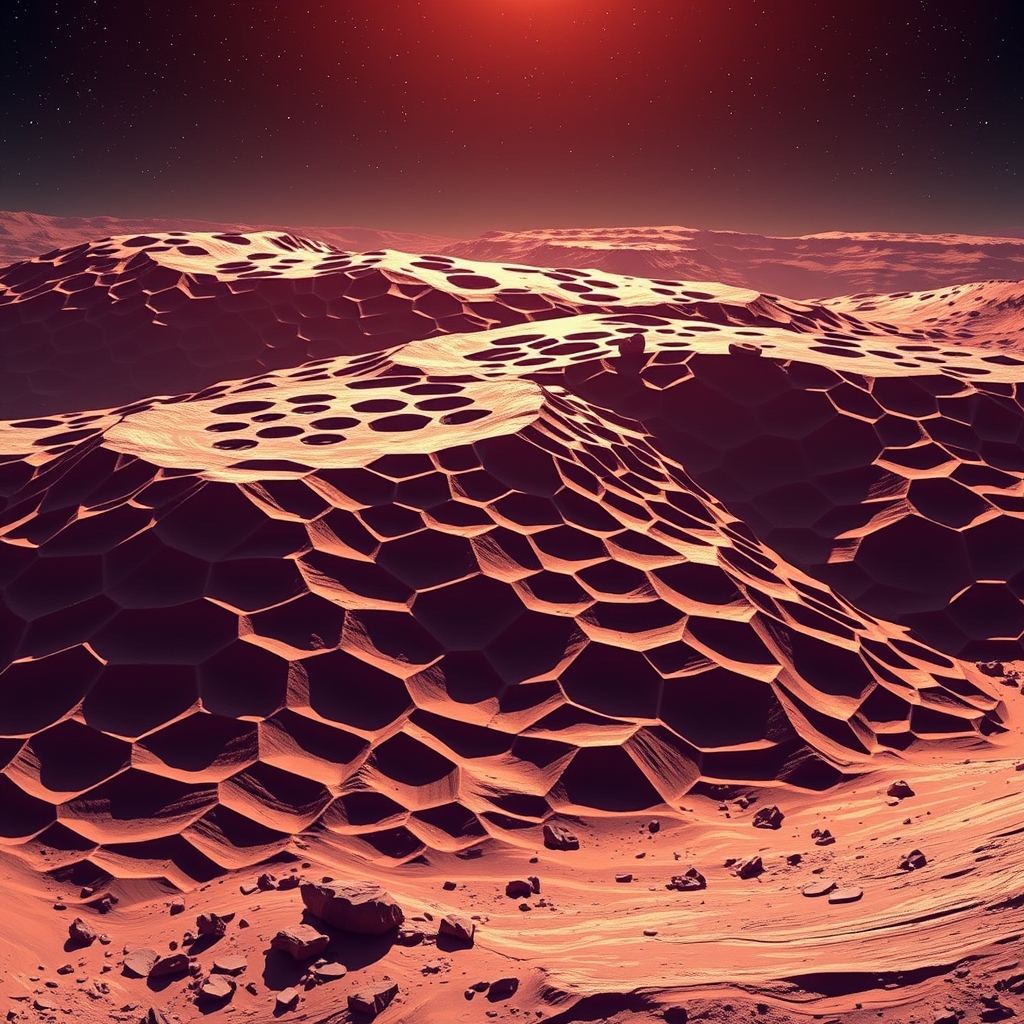
NASA’s veteran Curiosity rover has captured striking images of a honeycomb-like geological formation within the Gale Crater, sparking intense scientific debate. This discovery, made 14 years into the mission, presents a complex puzzle involving polygonal ridges and mysterious dark-toned rocks that challenge our current understanding of Martian evolution.
A Geological Enigma in Gale Crater
While exploring the Martian surface, the Curiosity rover encountered a unit covered in polygonal structures that bear a remarkable resemblance to a giant honeycomb. These geometric patterns were unexpectedly distinct when compared to previous orbital data, catching NASA mission scientists off guard. As the rover moved deeper into the unit, the ridges appeared more eroded, interspersed with dark-toned rocks ranging from pebble to cobble size.
The origin of these structures remains a primary scientific question. On Earth, similar polygonal patterns often result from drying mud, mineral crystallization, or the repeated freezing and thawing of soil. Given Mars' history of volcanic eruptions, flowing water, and shifting sediments, researchers are investigating whether similar environmental processes shaped this landscape or if a more exotic mechanism is at play.
The Mystery of the Dark-Toned Rocks
Adding a layer of complexity to the honeycomb discovery are the dark-toned cobbles scattered across the terrain. NASA scientists are currently using advanced instruments, including the Alpha Particle X-ray Spectrometer (APXS) and the Mars Hand Lens Imager (MAHLI), to analyze these features.
A critical point of investigation is whether these dark rocks are indigenous to Mars or extraterrestrial in origin. One prevailing theory is that they could be meteorites that fell on the Martian surface millions of years ago. Previous missions have identified dark rocks on Mars containing nickel—an element common in meteorites but rare in Martian crust—providing a precedent for this possibility. Other theories suggest the rocks may have been ejected from distant impacts or rolled down from higher geological strata within the Gale Crater.
Decoding the Martian Environment
The mission's current focus involves using ChemCam LIBS and RMI to target specific ridges and the "Cortadera" cobble to determine the chemical composition of these features. Understanding whether the honeycomb patterns and the dark rocks are linked or represent separate geological events is vital. If these structures were formed by water or climate-driven processes like freezing and thawing, they provide indirect evidence of the environmental conditions that once existed on the Red Planet, potentially touching upon the long-standing quest to find evidence of ancient microbial life.
What It Means for India
As India accelerates its own space ambitions through ISRO, developments in deep-space exploration carry significant weight for the nation’s strategic and scientific trajectory:
- Technological Benchmarking: For India’s burgeoning space sector, the longevity and success of the Curiosity mission serve as a technical benchmark for autonomous rover operations and long-term planetary exploration.
- Scientific Collaboration Opportunities: As Mars exploration enters a new phase of high-resolution data analysis, there are increasing opportunities for Indian scientists and academic institutions to participate in global data-sharing and collaborative research projects.
- Strategic Space Aspirations: Successes in Martian geology underscore the importance of investing in advanced remote sensing and autonomous robotics—areas that are critical as India moves toward more complex interplanetary missions and strengthens its position in the global space economy.
The surprise that broke the routine
The rover’s latest drive exposed a surface draped in crisp, hexagonal ridges that look like a giant beehive. From orbit the area appeared bland; only up close did the polygonal network emerge. The ridges are softened by erosion, and between them lie dark-toned cobbles ranging from pebble to cobble size. Their unexpected abundance and the stark contrast between light ridges and dark rocks caught the science team off guard.
Earth analogues: how similar patterns form
지구에서는 다각형 지각이 크게 세 가지 방식으로 형성됩니다. 첫째, 젖은 진흙이 마르면서 규칙적인 격자 모양으로 갈라질 수 있습니다. 둘째, 중심점에서 바깥쪽으로 성장하는 광물 결정이 때때로 벌집 모양의 질감을 만들어냅니다. 셋째, 포화된 토양이 반복적으로 얼고 녹는 현상(열 수축 균열로 알려짐)이 지면을 유사한 모양으로 쪼개 놓습니다. 각 과정은 고유한 화학적 지문을 남기므로, 화성에서 어떤 과정이 작용했는지(혹은 작용했는지 여부)를 확인하려면 사진 이상의 정보가 필요할 것입니다.
화성에서 일어났을 법한 일들
화성에는 화산 폭발, 흐르는 물, 이동하는 퇴적물의 기록이 남아 있습니다. 이 중 어떤 것이든 다각형 형성의 발판이 되었을 수 있습니다. 호수 바닥이 마르면서 기후가 건조해짐에 따라 진흙이 갈라졌을 수도 있습니다. 또는 광물이 풍부한 염수가 결정을 침전시켰고, 이것이 나중에 침식되어 관찰된 능선이 되었을 수도 있습니다. 해당 지역이 과거에 물이나 이산화탄소 얼음의 어는점 부근에서 온도 변화를 겪었다면 동결-융해 주기도 충분히 가능성 있는 시나리오입니다.
어두운 자갈: 운석인가, 현지 파편인가?
다각형들 사이에는 화성 토착 물질이거나 외계에서 온 운석 파편일 수 있는 어두운 암석들이 흩어져 있습니다. 로버의 APXS(Alpha Particle X-ray Spectrometer)와 MAHLI(Mars Hand Lens Imager)는 현재 원소 구성과 표면 질감을 측정하고 있습니다. 이전의 화성 탐사 임무들이 니켈이 풍부한 어두운 돌들을 발견했기 때문에 운석 가설이 힘을 얻고 있습니다. 니켈은 운석에는 풍부하지만 화성 지각에는 드문 금속입니다. 하지만 또 다른 관점에서는 이 자갈들이 고대의 산사태 동안 게일 크레이터(Gale Crater) 내부의 높은 지층에서 떨어져 나왔거나, 먼 곳의 충돌로 인해 튕겨져 나와 나중에 이곳에 퇴적된 것이라고 주장합니다. 곧 분석 장비들을 통해 화학 성분이 알려진 운석의 특징과 일치하는지, 아니면 현지의 현무암질 암석과 일치하는지가 밝혀질 것입니다.
사진을 화학 분석으로 전환하기
이 미스터리를 풀기 위해, Curiosity는 능선 꼭대기와 “Cortadera”라는 별명이 붙은 가장 큰 어두운 자갈 모두에 ChemCam 레이저 유도 분광법(LIBS) 시스템을 발사하고 있습니다. LIBS는 물질의 아주 작은 부분을 기화시켜 그 결과로 발생하는 빛의 스펙트럼을 읽어냄으로써 신속하게 원소 성분을 알려줍니다. 동시에 RMI(Remote Micro-Imager)는 고해상도 문맥 이미지를 기록하여 화학 성분과 지형적 형태를 연결합니다. 이러한 도구들을 통해 과학자들은 능선이 자갈과 공통된 성분을 공유하는지, 아니면 별개의 지질학적 사건을 나타내는지 테스트할 수 있습니다.
인도 과학자들이 주목해야 하는 이유
- 기술적 기준점 – 10년 넘게 자율적으로 작동해 온 Curiosity의 능력은 인도의 자체 로버 개발 계획에 중요한 참고 지표를 제공합니다.
- 협력의 기회 – 쏟아지는 고해상도 데이터는 인도의 대학과 연구 기관이 국제 분석 팀에 참여할 수 있도록 유도하며, 최첨단 행성 데이터 세트에 접근할 기회를 제공합니다.
- 전략적 중요성 – 화성 표면 과정을 이해하는 것은 향후 인도의 행성 간 탐사선 설계, 특히 복잡한 지형을 탐사하거나 샘플을 채취해야 하는 탐사선 설계에 유용한 정보를 제공합니다.
남은 질문과 향후 단계
로버는 벌집 모양의 지형을 계속해서 매핑하며, 패턴이 지표면 아래에서도 지속되는지 확인하기 위해 더 깊은 층을 조사할 것입니다.