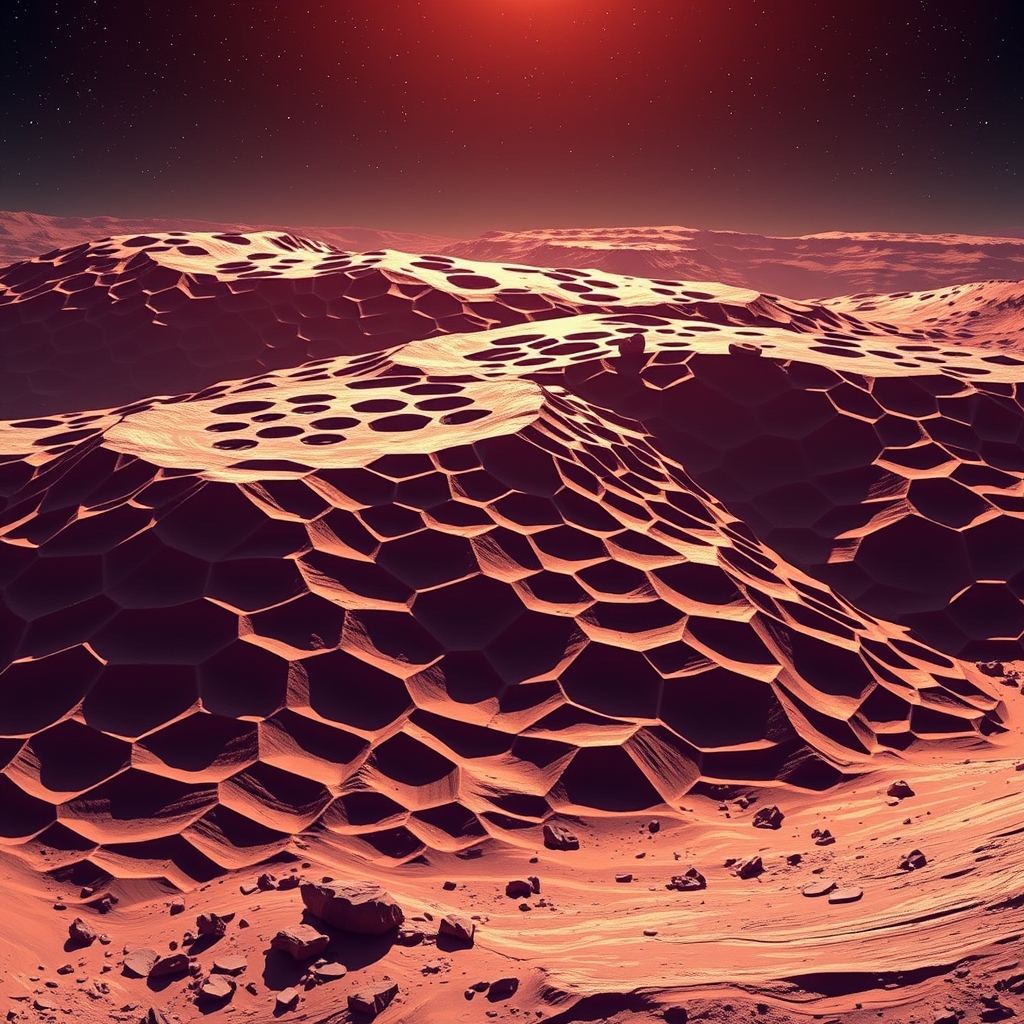
NASA 的资深好奇号(Curiosity)火星车在盖尔撞击坑(Gale Crater)内拍摄到了令人惊叹的类蜂窝状地质构造图像,引发了激烈的科学辩论。这一发现是在任务开展 14 年后做出的,呈现了一个涉及多边形脊状结构和神秘深色岩石的复杂谜题,挑战了我们目前对火星演化的认知。
盖尔撞击坑的地质之谜
在探测火星表面的过程中,好奇号火星车遇到了一片被多边形结构覆盖的地层,这些结构与巨大的蜂窝状极其相似。与之前的轨道数据相比,这些几何图案出人意料地清晰,让 NASA 的任务科学家们措手不及。随着火星车深入该地层,脊状结构显得侵蚀程度更高,其间散布着从卵石到块石大小的深色岩石。
这些结构的起源仍然是一个主要的科学问题。在地球上,类似的多边形图案通常是由干涸的泥浆、矿物结晶或土壤的反复冻融形成的。考虑到火星曾有过火山喷发、流水流动和沉积物迁移的历史,研究人员正在调查是类似的各种环境过程塑造了这一景观,还是存在某种更奇特的机制。
深色岩石之谜
散布在地形中的深色块石为这一蜂窝状发现增添了复杂性。NASA 的科学家目前正在使用先进的仪器,包括 Alpha Particle X-ray Spectrometer (APXS) 和 Mars Hand Lens Imager (MAHLI),来分析这些特征。
调查的一个关键点是这些深色岩石是火星本土的,还是外星起源。一种流行的理论是,它们可能是数百万年前坠落在火星表面的陨石。此前的任务已在火星上发现了含有镍的深色岩石——镍是陨石中常见的元素,但在火星地壳中却很罕见——这为这种可能性提供了先例。其他理论则认为,这些岩石可能是从远处的撞击中喷射出来的,或者是从盖尔撞击坑内较高的地质层滚落下来的。
解码火星环境
该任务目前的重点是利用 ChemCam LIBS 和 RMI 针对特定的脊状结构和“Cortadera”块石进行探测,以确定这些特征的化学成分。了解蜂窝状图案与深色岩石之间是否存在联系,或者它们是否代表了独立的地质事件,这一点至关重要。如果这些结构是由水或冻融等气候驱动的过程形成的,它们将为曾经存在于这颗红色星球上的环境条件提供间接证据,并可能触及寻找古代微生物生命证据这一长期课题。
这对印度意味着什么
随着印度通过 ISRO 加速实现其航天雄心,深空探测的发展对该国的战略和科学轨迹具有重大意义:
- 技术标杆: 对于印度蓬勃发展的航天领域而言,好奇号任务的持久性和成功为自主火星车运行和长期行星探测提供了技术标杆。
- 科学合作机会: 随着火星探测进入高分辨率数据分析的新阶段,印度科学家和学术机构参与全球数据共享和协作研究项目的机会正在增加。
- 战略航天愿景: 火星地质学的成功凸显了投资先进遥感技术和自主机器人技术的重要性——随着印度迈向更复杂的星际任务并加强其在全球太空经济中的地位,这些领域至关重要。
打破常规的惊喜
火星车的最新行驶路径揭示了一个覆盖着清晰六边形脊状结构的表面,看起来像一个巨大的蜂巢。从轨道上看,该区域显得平淡无奇;只有近距离观察时,多边形网络才显现出来。这些脊状结构因侵蚀而变得圆润,其间散布着从卵石到块石大小的深色块石。它们出人意料的丰富程度,以及浅色脊状结构与深色岩石之间的鲜明对比,让科学团队措手不及。
地球类比:相似图案是如何形成的
On our planet, polygonal crusts arise in three main ways. First, when wet mud dries it can crack into a regular grid. Second, mineral crystals that grow outward from a central point sometimes produce a honeycomb texture. Third, repeated freezing and thawing of saturated soil—known as thermal contraction cracking—splits the ground into similar shapes. Each process leaves a distinct chemical fingerprint, so identifying which, if any, operated on Mars will require more than photographs.
What Mars might have done
Mars has a record of volcanic eruptions, flowing water, and shifting sediments. Any of these could have set the stage for polygon formation. A drying lakebed could have left mud that cracked as the climate dried. Alternatively, mineral-rich brines might have precipitated crystals that later eroded into the observed ridges. Freeze-thaw cycles are plausible if the region once experienced temperature swings around the freezing point of water or carbon dioxide ice.
The dark cobbles: meteorites or local debris?
Scattered among the polygons are dark rocks that could be either native Martian material or foreign meteoritic fragments. The rover’s Alpha Particle X-ray Spectrometer (APXS) and Mars Hand Lens Imager (MAHLI) are currently measuring elemental composition and surface texture. A meteorite hypothesis gains traction because previous Martian missions have found dark stones enriched in nickel—a metal abundant in meteorites but scarce in the planet’s crust. Yet an alternative view holds that the cobbles were ripped from higher strata within Gale Crater during ancient landslides, or ejected from distant impacts and later deposited here. The instruments will soon reveal whether the chemistry aligns with known meteorite signatures or matches local basaltic rocks.
Turning pictures into chemistry
To untangle the mystery, Curiosity is firing its ChemCam laser-induced breakdown spectroscopy (LIBS) system at both ridge tops and the largest dark cobble, nicknamed “Cortadera.” LIBS vaporizes a tiny spot of material and reads the resulting light spectrum, delivering a rapid elemental readout. The Remote Micro-Imager (RMI) simultaneously records high-resolution context images, linking chemistry to morphology. Together these tools let scientists test whether the ridges share a common composition with the cobbles or represent separate geological episodes.
Why Indian scientists should care
- Technical benchmark – Curiosity’s ability to operate autonomously for over a decade provides a reference point for India’s own rover development plans.
- Collaboration doors – The flood of high-resolution data invites Indian universities and research institutes to join international analysis teams, offering access to cutting-edge planetary datasets.
- Strategic relevance – Understanding Martian surface processes informs the design of future Indian interplanetary probes, especially those that will need to navigate or sample complex terrains.
Open questions and next steps
The rover will continue to map the honeycomb field, probing deeper layers to see if the pattern persists below the surface. It.