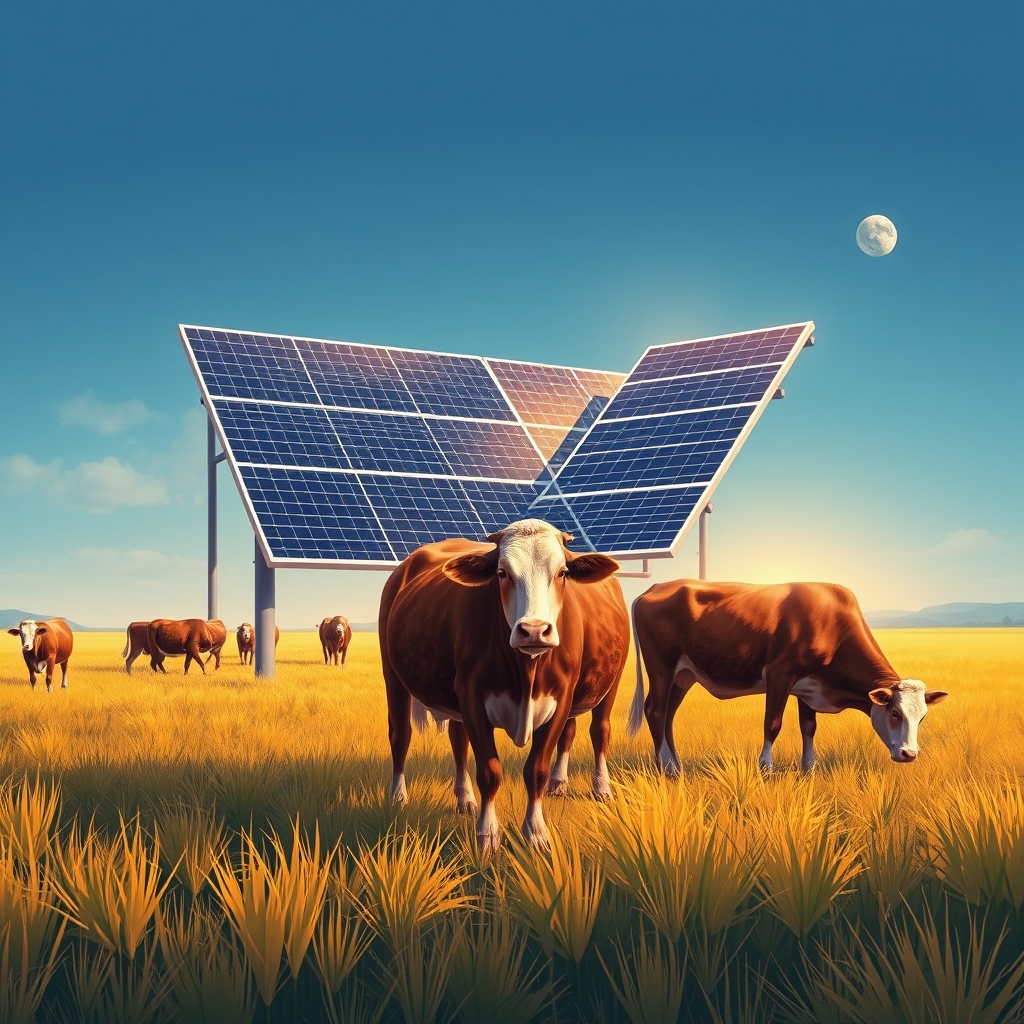
随着全球可再生能源竞赛的加剧,新泽西州的一项开创性实验正在测试一个至关重要的假设:太阳能发电与畜牧业可以在同一块土地上共存。通过将立式太阳能电池板与放牧牧场相结合,研究人员正试图寻找一种解决清洁能源基础设施与农业生产力之间日益增长的紧张关系的方法。
新泽西州实验:奶牛与无碳电力
罗格斯大学(Rutgers University)新泽西州农业实验站目前正在其“农光互补项目”(Agrivoltaics Program)下进行一项复杂的研究所。与利用倾斜阵列并占用大片土地的传统太阳能农场不同,该项目采用了立式双面太阳能电池板。这些电池板旨在从两侧捕捉阳光,其直立的布局允许在行间保留宽阔的牧场条带。
该研究包含一组特定的牛群,包括安格斯牛(Ideal、Queen、Fizzle 和 Blossom)和海福特牛(Misty 和 Flurry),它们作为这项科学试验的活体受试对象。研究人员正在利用高频摄像监控——每五分钟拍摄一次照片——来追踪动物行为。目标是确定牛群是更喜欢电池板提供的阴凉,还是电池板会干扰它们的自然放牧和休息模式。
面向多用途景观的工程设计
该项目不仅仅是让动物漫步;它是一项高度受控的工程和生物学测试。实验场地被分为三个重复区块,使科学家能够将不同的太阳能布局与完全没有电池板的“对照”牧场进行比较。
测试的变量包括:
- 电池板间距 (Panel Spacing): 行间距离如何影响牛群的移动和农用机械的进入。
- 地面净空 (Ground Clearance): 确定电池板下方需要多少空间以防止阻碍。
- 植被健康 (Vegetation Health): 监测不断变化的阴影带如何影响土壤水分、温度以及牧草的营养价值。
如果研究证明在立式电池板的阴影下牧场质量仍能保持高水平,它将为“农光互补”(agrivoltaics)提供蓝图——这是一种土地不再是能源开发商与农民之间“零和博弈”的模型。
应对全球土地竞争
这项研究解决的核心矛盾是生产性土地日益激烈的竞争。随着各国向绿色能源转型,大规模的太阳能设施通常需要转化肥沃的农用土壤,从而威胁到粮食安全和农村社区的生计。农光互补提供了一种“双赢”的技术干预手段,允许在不牺牲养活不断增长的人口能力的情况下实现分散式能源生产。
对印度的意义
对于像印度这样面临着既要实现大规模可再生能源目标,又要保护其庞大农业基础的双重挑战的国家来说,这一进展具有重要的战略意义:
- 保护粮食安全: 随着印度扩大太阳能产能以实现气候目标,采用农光互补模式可以防止农民流离失所,并确保生产性的放牧和农耕土地不会因能源基础设施而丧失。
- 优化人口密集州的土地利用: 在人口密度高且土地资源有限的邦,立式和双面太阳能技术可以实现“双重用途”土地政策,最大限度地提高每公顷的经济产出。
- 农民的气候韧性: 太阳能电池板提供的阴影有可能创造微气候,减少土壤蒸发和牲畜的热应激,从而在印度气温上升的情况下稳定农业产量。
罗格斯大学的研究人员在新泽西州的一块工作牧场上安装了一排立式双面太阳能电池板,并在电池板发电的同时监测一小群安格斯牛和海福特牛。这项实验之所以重要,是因为它测试了可再生能源基础设施是否能与牲畜放牧共存——这个问题可能会影响快速增长的经济体如何在保护发电能力的同时兼顾粮食生产。
为什么这项试验在当下至关重要
Governments worldwide are racing to add gigawatts of solar capacity, but large-scale farms often have to give up productive soil to accommodate tilted arrays. That trade-off threatens food security and the livelihoods of rural communities. Agrivoltaics—placing solar collectors among crops or pasture—offers a way to keep the land “working” for both energy and agriculture.
The New Jersey field test
The New Jersey Agricultural Experiment Station’s Agrivoltaics Program set up three replicated blocks on a research farm. Each block contains a different configuration of upright panels, while a fourth “control” block has no panels at all. The panels stand on steel frames, face both north-south sides, and leave wide strips of grass between rows for cows to move freely.
A handful of cattle—four Angus cows named Ideal, Queen, Fizzle and Blossom, plus two Herefords called Misty and Flurry—are the living test subjects. High-frequency cameras snap a picture every five minutes, feeding data on grazing patterns, shade use, and resting behavior into a central analytics platform. Researchers are also measuring:
- Panel spacing – how the distance between rows influences cattle movement and the ability of tractors to pass.
- Ground clearance – the minimum height needed under the panels to avoid trampling or obstruction.
- Vegetation health – soil moisture, temperature, and the nutritional value of the forage in shaded versus sun-exposed strips.
By comparing the three panel layouts with the control pasture, the team hopes to isolate the design that maximizes power output while keeping forage quality and animal welfare intact.
The broader stakes
- Energy security – Vertical bifacial panels generate power from both sides.
- Food security – Keeping grazing land in production avoids the need to convert cropland or pasture into solar fields, a critical concern for regions where arable land is already scarce.
Counter-points and challenges
Critics point out that shading can lower photosynthesis, potentially reducing grass growth if panels are too dense. Maintenance crews also face the logistical hurdle of servicing tall, upright arrays in a working pasture. Scaling the model beyond a research farm will require clear answers to these cost-benefit questions.
What India could learn
India plans to install hundreds of gigawatts of solar capacity over the next decade, yet the country’s agricultural sector still employs a large share of the workforce and occupies the majority of its land surface. Policy frameworks would need to address financing, land-lease agreements, and training for farmers to manage hybrid installations.
What to watch next
- Full-season results – The Rutgers team plans to publish a comprehensive dataset after one full grazing cycle, covering power output, forage quality, and animal health metrics.
- Cost analysis – A detailed life-cycle cost comparison between vertical agrivoltaics and conventional solar farms will clarify economic viability.
- Policy pilots – Early adopters in regions with tight land constraints may launch pilot programs, using Rutgers data as a technical template.
- Technology refinements – Improvements in panel materials, tracking systems, and livestock-monitoring sensors could lower costs and increase adoption speed.
If the vertical agrivoltaics model proves that cows can graze comfortably under a power-producing canopy, it would offer a concrete pathway for countries like India to meet renewable-energy targets without sacrificing the land that feeds their people. The experiment in New Jersey could become the blueprint for a new class of farms that generate clean electricity and sustain food production on the same plot of earth.