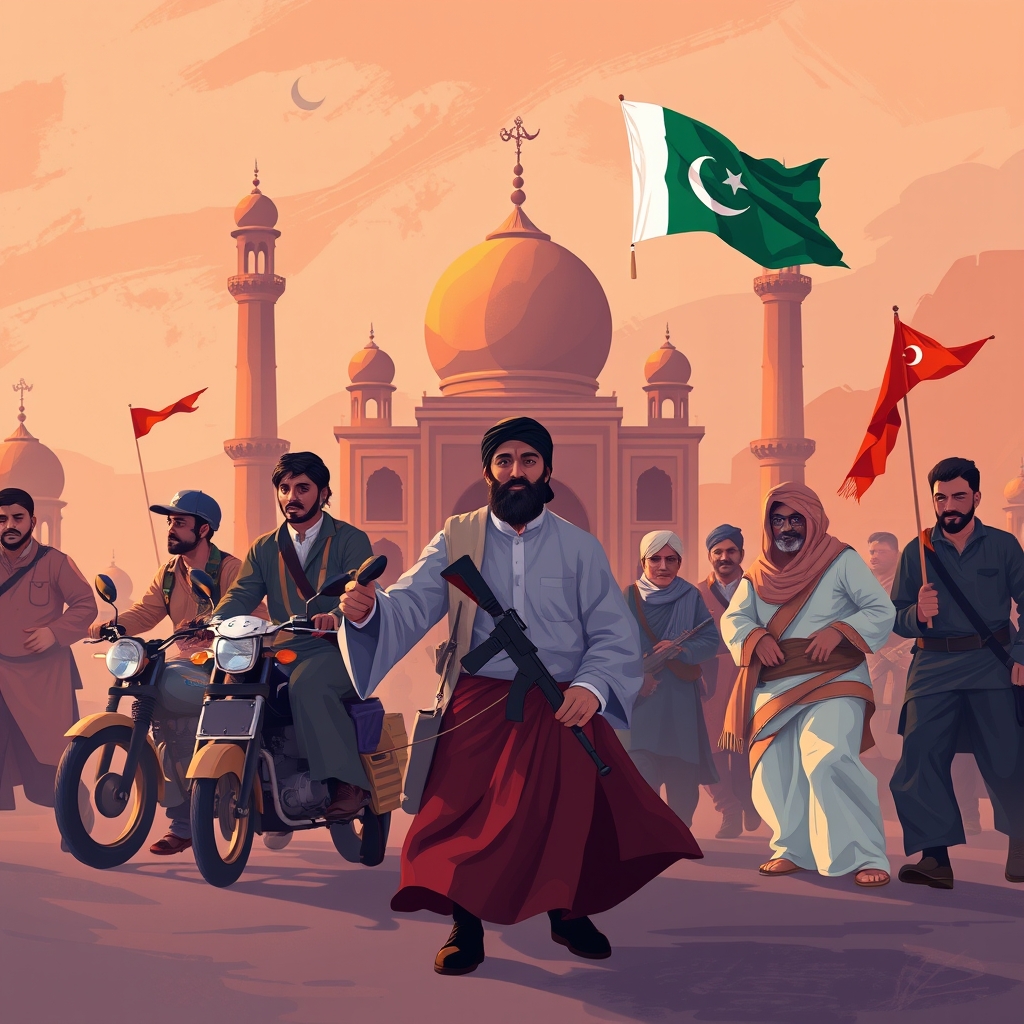
Pakistan’s Peacemaker Facade vs. The Reality of Balochistan’s Crisis
While Pakistan seeks global recognition as a diplomatic mediator between major powers, a profound human rights crisis continues to fester within its own borders. The stark contrast between Islamabad’s international posturing and its domestic crackdown in Balochistan reveals a state struggling to balance regional diplomacy with internal stability.
The Human Cost of Enforced Disappearances
The internal security situation in Pakistan is underscored by a long-standing pattern of enforced disappearances, particularly in the Balochistan province. As highlighted by the harrowing account of activists whose family members were abducted by intelligence agencies, the issue has transcended personal grief to become a systemic administrative crisis. For the families of the disappeared, the state's actions create a "limbo" where individuals cannot access basic rights, such as school admissions, passports, or medical guardianship, due to the absence of a legal father or head of household.
Since the eruption of the insurgency in 2000, thousands of students, political activists, and ordinary citizens have vanished. Many have later been found dead, showing signs of torture. The state's response to these disappearances has not been reconciliation, but rather a hardening of security measures. Peaceful activists are increasingly being categorized alongside militants, facing arrests under terrorism laws, placement on the Exit Control List (ECL), and inclusion in the "Fourth Schedule"—a domestic anti-terror watchlist that effectively blacklists citizens from basic civil life, including banking and travel.
Diplomatic Posturing vs. Domestic Crackdown
There is a growing disconnect between Pakistan’s role on the global stage and its domestic governance. While international media outlets have praised Islamabad for its role in mediating talks between the United States and Iran, the local reality remains one of suppression. The same administration that facilitates high-level international dialogue often meets peaceful domestic protesters with intimidation and arrest.
Recent escalations, such as the March 2025 hijacking of a train by Baloch militants, have provided the state with justifications to further tighten its grip. Following these incidents, human rights defenders have faced mass arrests in cities like Karachi. This cycle of militant violence and heavy-handed state retaliation creates a volatile environment where the space for peaceful political expression is shrinking, even as the government attempts to project an image of a stable, mediating regional power.
The Failure of Political Promises
Despite the establishment of the Commission of Inquiry on Enforced Disappearances in 2011, the systemic issue remains unresolved. The political landscape in Pakistan shows a recurring pattern: leaders across the spectrum, including figures like Maryam Nawaz Sharif and Imran Khan, have acknowledged the plight of the disappeared while in opposition, only to fail to implement substantive reforms once in power. This inconsistency suggests that the issue of Balochistan is often treated as a political tool rather than a genuine human rights priority.
What It Means for India
- Regional Instability: The deepening chasm between the Pakistani state and the Baloch population increases the risk of prolonged internal insurgency, which can spill over borders and destabilize the immediate neighborhood.
- Security Implications: As Pakistan's security apparatus shifts focus toward domestic counter-terrorism and crackdowns, the volatility in Balochistan may create vacuum or unpredictable security dynamics along the shared borders.
- Diplomatic Contradictions: India must observe the widening gap between Pakistan's international "peacemaker" branding and its domestic volatility, as this duality often masks underlying structural weaknesses that impact South Asian regional security.