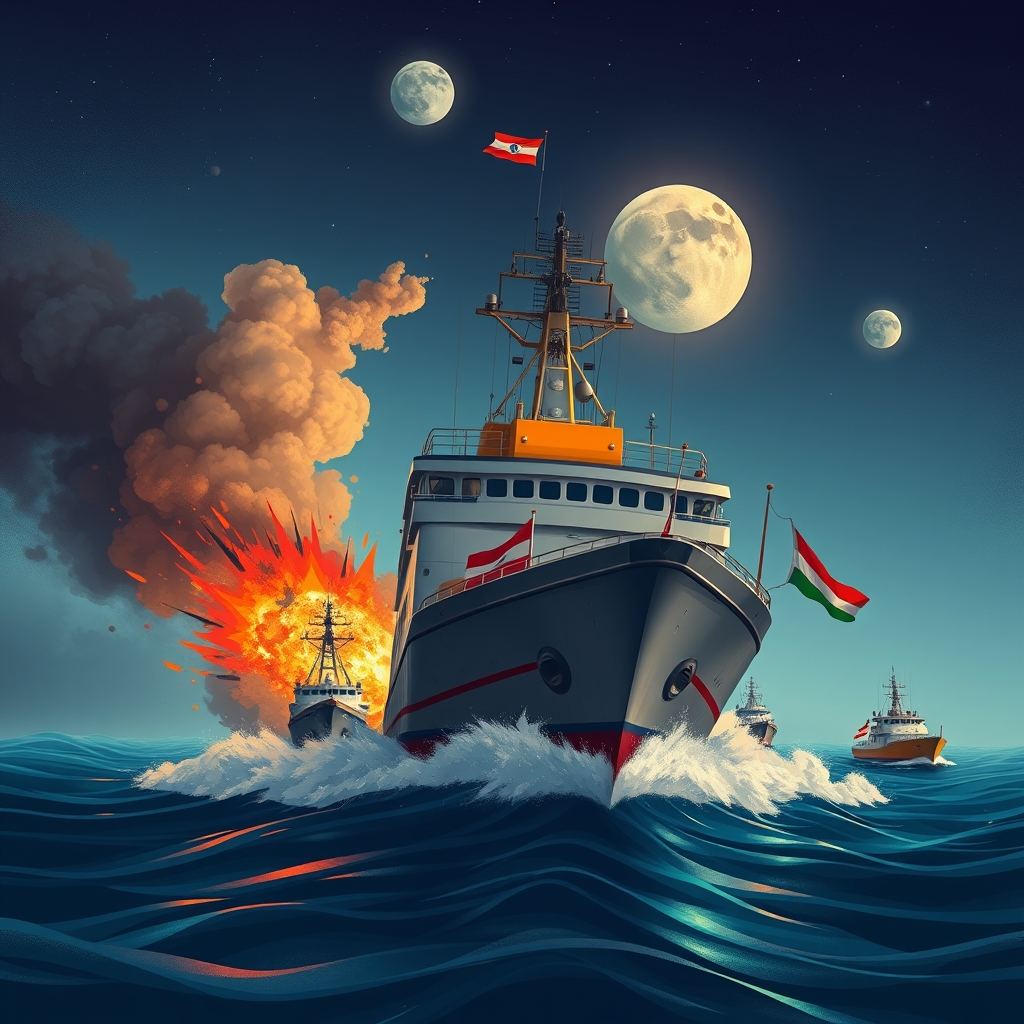
US forces fired Hellfire missiles at the Curacao-flagged tanker M/T Belma on July 14, blowing out its smokestack and halting the ship before it could reach Iran’s Kharg Island oil terminal. It was the first time the United States used kinetic weapons against a commercial vessel in its renewed Gulf blockade, shifting from passive monitoring to active interdiction.
How the engagement unfolded
CENTCOM said a surveillance aircraft spotted the tanker in international waters heading for Kharg Island, a hub for Iran’s crude exports. The vessel ignored several warnings to turn back. The aircraft then launched two Hellfire missiles that struck the smokestack, crippling the propulsion system. CENTCOM confirmed the ship is no longer en route to Iran. The attack occurred within the first 24 hours of the renewed enforcement, a period that also saw two other commercial ships redirected after complying with the blockade.
Why the United States changed tactics
In recent years US naval patrols in the Arabian Gulf have relied on tracking and boarding, leaving seizure decisions to senior commanders. The Belma incident shows Washington willing to use precision fire to achieve the same result without sinking a ship. By targeting a non-vital structure rather than the hull, the US can stop a non-compliant vessel while limiting loss of life and environmental fallout.
The shift serves two purposes. First, it tells shipping operators that ignoring the blockade will trigger a kinetic response, raising the cost of non-compliance. Second, it gives Washington a scalable tool: a missile strike can disable a ship’s engine, and a boarding team can be deployed later if the captain agrees to comply. The approach threads a narrow line between a “soft” blockade that leans on diplomatic pressure and a “hard” one that risks open conflict.
The stakes for Iran and the global oil market
Kharg Island processes a sizable share of Iran’s oil shipments. Cutting traffic to the island squeezes Tehran’s ability to earn foreign currency, a key pillar of its economy under sanctions. The United States hopes a tighter maritime chokehold will force Tehran to reconsider its regional policies, especially its nuclear program and support for proxy groups.
For oil markets, any Gulf disruption reverberates worldwide. Even a single delayed tanker can shift supply curves enough to lift spot prices. Insurers already flag the Strait of Hormuz as high-risk; a precedent of missile strikes on commercial ships could push premiums higher and encourage carriers to take longer, costlier routes around the Cape of Good Hope.
Risks to commercial shipping
The Belna case raises immediate concerns for ship owners, insurers and charterers. Vessels that treated the Gulf as a routine leg may now have to factor in the possibility of a missile-based interdiction. The threat is not limited to Iranian-bound traffic; any vessel that appears to flout a US-issued warning could become a target, regardless of flag.
Legal experts warn that using force in international waters sits on a slippery slope. Under the United Nations Convention on the Law of the Sea, a state may take “necessary” measures to enforce a blockade, but the definition of “necessary” is contested. Critics argue that striking a commercial tanker without a boarding or seizure could be deemed excessive, inviting diplomatic protests or reciprocal actions.
Counter-argument: the case for restraint
Proponents of the kinetic approach argue that a precise missile strike is less risky than a boarding operation, which can turn violent and endanger crews. They also note that the US has avoided sinking ships, limiting environmental damage. Opponents counter that any use of weapons against civilian vessels raises the specter of miscalculation. A mis-targeted missile could cause fire, a spill, or loss of life, eroding the moral high ground the United States claims in its sanctions regime.
What to watch next
- Déclarations de la politique américaine – Les clarifications du CENTCOM ou du Département d'État sur les règles d'engagement révéleront si la frappe de missile était un incident isolé ou le début d'une doctrine plus large.
- Activité navale régionale – Historiquement, les forces iraniennes ont répondu aux blocus par des manœuvres de « démonstration de force ». Une intensification des patrouilles iraniennes ou le déploiement d'embarcations rapides d'attaque pourrait accroître le risque d'un affrontement direct.
- Assurances et taux de fret – Une hausse mesurable des primes d'assurance maritime ou un changement dans les schémas de fret signaleraient que le marché perçoit la nouvelle menace comme réelle.
- Défis juridiques – Tout dépôt de plainte devant un tribunal international ou toute protestation formelle de l'État du pavillon du Belma pourrait mettre à l'épreuve la légalité de l'interdiction cinétique en temps de paix.
Implications pour l'Inde
L'Inde importe une grande partie de son pétrole brut du Golfe, et sa flotte marchande transite régulièrement par le détroit d'Ormuz. Le blocus cinétique pourrait se traduire par une hausse des coûts de fret, des conditions d'assurance plus strictes et la nécessité de plans de routage plus élaborés. Sur le plan diplomatique, New Delhi doit équilibrer son partenariat stratégique avec Washington et sa dépendance économique au pétrole du Golfe, tout en garantissant la stabilité des voies de navigation. Une escalade prolongée pourrait contraindre l'Inde à plaider pour des mécanismes de désescalade multilatéraux ou à développer des routes d'approvisionnement alternatives, telles qu'une augmentation des importations en provenance de Russie ou des États-Unis.
À retenir
La frappe de missile sur le M/T Belma montre que les États-Unis sont prêts à employer une force cinétique précise pour faire respecter leur blocus maritime de l'Iran. Ce choix ajoute une nouvelle couche de risque pour le transport maritime commercial, complique les débats juridiques sur l'usage de la force dans les eaux internationales et pourrait avoir des répercussions sur les marchés mondiaux du pétrole. La manière dont les États-Unis, l'Iran et la communauté internationale au sens large réagiront façonnera le calcul de sécurité de l'une des voies maritimes les plus fréquentées au monde pour les mois à venir.