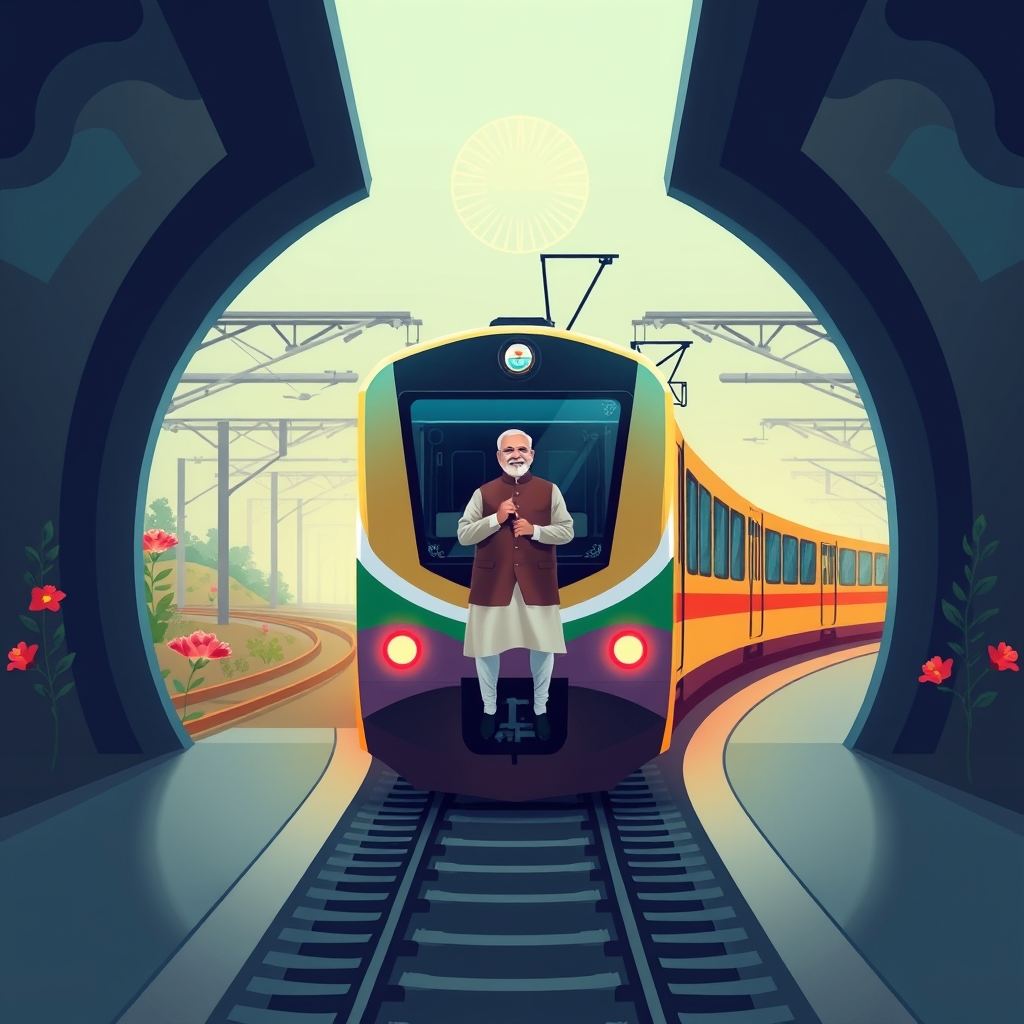
On July 17, Prime Minister Narendra Modi will flag off India’s first hydrogen-powered train on the Jind–Sonipat route in Haryana. The event is more than a ribbon-cutting. It signals that Indian Railways, one of the world’s largest rail networks, is now ready to test hydrogen fuel cell technology on its own tracks, moving beyond diesel and conventional electric traction in its search for cleaner propulsion.
How the Technology Works
This train runs on hydrogen fuel cells rather than drawing power from overhead electric wires or burning diesel in an engine. In simple terms, a fuel cell is an electrochemical device. Stored hydrogen from onboard tanks reacts with oxygen drawn from the air. The reaction generates electricity to power the traction motors, and the only direct emission is water vapor and a little heat. There is no exhaust smoke, no sulfur dioxide, and no carbon dioxide coming out of a tailpipe during operation.
That distinction matters. Diesel locomotives release pollutants at ground level along every kilometer they run. Even electric trains, while running clean on the track, carry an indirect emissions burden if the grid electricity that feeds them comes from coal. A hydrogen train shifts the pollution question upstream to how the hydrogen itself is made. If the hydrogen is produced using renewable energy—often termed green hydrogen—the entire cycle can approach near-zero emissions. For now, the immediate benefit is the removal of combustion from the vehicle itself, which sharpens air quality along railway corridors and eliminates noise and soot at stations.
The Jind–Sonipat Corridor
Indian Railways has chosen a regional stretch in Haryana for this debut. The Jind to Sonipat line is not the country’s busiest trunk route, and that is precisely the point. A pilot project on a shorter corridor allows engineers to monitor fuel consumption patterns, refueling logistics, braking energy recovery, and component wear in real-world Indian conditions without risking disruption on a high-density mainline.
Haryana’s relatively flat terrain and dry climate offer a manageable testing ground, though the summer heat and dust will still challenge the fuel cell stacks and air filtration systems. Running the train here lets the railway gather data on how hydrogen storage behaves in daily stop-start service, and how maintenance crews adapt to a technology that has never before operated on a commercial Indian route.
Why Hydrogen, and Why Now
Indian Railways has electrified track at a rapid clip over the past decade. Yet complete electrification across tens of thousands of route kilometers remains expensive and technically difficult on certain stretches. Remote branch lines, hilly terrain, and sections with low traffic density often do not justify the capital cost of erecting and maintaining overhead catenary wire.
Hydrogen trains fill that gap. They carry their own energy supply, which means they do not need overhead lines. They can run on non-electrified routes while still offering the performance and zero-local-emission profile of an electric multiple unit. For India, the timing also aligns with the National Green Hydrogen Mission, which aims to build domestic production capacity and bring down the cost of green hydrogen. If the country can produce affordable green hydrogen at scale, fuel cell trains become a far more compelling replacement for the diesel fleets that still serve hundreds of secondary routes.
What Passengers Will Notice
From a traveler’s perspective, the first difference will likely be the quiet. Fuel cell multiple units run almost silently compared to the rumble and clatter of diesel engines. Platforms will not smell of exhaust. Acceleration tends to be smooth because electric traction motors deliver torque evenly.
That said, passengers will not see the complexity hidden beneath the floor and roof: high-pressure hydrogen storage cylinders, battery buffers to handle peak power demands, power management systems, and safety cutoffs. Crews will need specialized training. Hydrogen is highly flammable, and though the storage and delivery systems are engineered to exacting standards, railway yards will need new protocols for refueling, leak detection, and emergency response.
The Harder Problems Still Ahead
Lanzar un solo tren es un logro. Escalar la tecnología es más difícil. La producción de hidrógeno verde en la India aún se encuentra en sus etapas iniciales. La mayor parte del hidrógeno producido a nivel mundial hoy en día se deriva del gas natural en un proceso que emite dióxido de carbono. A menos que la cadena de suministro de hidrógeno se limpie, el beneficio ambiental del tren en sí mismo será parcial.
El costo es otra realidad. El material rodante de celdas de combustible de hidrógeno es actualmente más caro de adquirir que las unidades múltiples diésel convencionales. El combustible, medido por unidad de energía útil, también es más costoso que extraer energía directamente de una catenaria electrificada. Esto significa que es poco probable que los trenes de hidrógeno reemplacen las líneas principales de gran tráfico que ya están electrificadas o cuya electrificación está planificada. Su hogar práctico probablemente serán las rutas regionales no electrificadas, las zonas suburbanas y, tal vez, las líneas históricas donde extender catenarias sea física o financieramente inviable.
La infraestructura de repostaje debe construirse desde cero. A diferencia del diésel, que puede transportarse en camiones cisterna y almacenarse con una logística establecida, el hidrógeno requiere almacenamiento presurizado o criogénico y sistemas de despacho dedicados en los depósitos ferroviarios. Cada uno de estos elementos debe demostrar ser seguro y confiable bajo el clima y las rutinas operativas de la India.
Una señal para el ecosistema
El lanzamiento del 17 de julio no transforma a Indian Railways de la noche a la mañana. Una ruta en Haryana no compensa las emisiones de una red que transporta a más de ocho mil millones de pasajeros al año. Pero el inicio de operaciones obliga a entablar una serie de conversaciones cruciales. Les indica a los fabricantes de material rodante que la India está abierta a contratos de celdas de combustible. Les indica a los proveedores de energía que habrá una demanda predecible de hidrógeno verde si pueden suministrarlo de manera asequible. Y les indica a los ingenieros ferroviarios que comiencen a desarrollar experiencia en mantenimiento ahora, mientras la flota es pequeña, en lugar de intentar ponerse al día más tarde.
Otros países ya han puesto trenes de hidrógeno en servicio piloto o comercial limitado, y la entrada de la India en este campo significa que puede estudiar lo que funcionó en otros lugares mientras adapta el hardware a los anchos de vía locales, las cargas por eje y las tensiones climáticas. La verdadera prueba comienza después del recorrido inaugural, cuando el tren deba funcionar bajo el calor del verano, la humedad del monzón y la suciedad acumulada del servicio diario, sin el benevolente foco de un evento de lanzamiento.
La verdadera conclusión
El primer tren de hidrógeno de la India es un hito genuino, pero es mejor entenderlo como un laboratorio sobre ruedas. La ruta entre Jind y Sonipat es corta y la tecnología aún es costosa. Sin embargo, al poner en servicio regular un tren de celdas de combustible, Indian Railways se compromete a responder a las preguntas difíciles bajo sus propios términos: ¿Se puede producir hidrógeno limpio de forma suficientemente barata? ¿Pueden las tripulaciones mantener este equipo de manera confiable? ¿Y puede el sistema justificar el costo en corredores donde el diésel es actualmente la única opción?
Si los datos de Haryana resultan positivos, la tracción por hidrógeno podría extenderse lentamente a otras líneas secundarias no electrificadas, brindando a la India una alternativa práctica de cero emisiones donde las catenarias nunca llegarán. Ese resultado haría que el 17 de julio no fuera solo una fecha de lanzamiento, sino el punto de partida de un cambio lento y necesario en la forma en que se desplazan mil millones de personas.
Únete a la comunidad de aprendizaje de GyaanSetu: https://t.me/GyaanSetuBharat
Fuente: India TV News